
Middle East Accessibility Policies: Slow Change or Silent Revolution?

Middle East Accessibility Policies are undergoing a profound, technology-driven metamorphosis that is reshaping the social landscape from Riyadh to Muscat.
As we move through late 2025, the region has moved beyond mere legislative promises to implement enforceable, high-tech standards for millions of citizens.
This shift represents a “silent revolution” where inclusion is no longer viewed as charity, but as a vital pillar of economic diversification.
By integrating accessibility into national visions, Gulf nations are unlocking the untapped potential of a significant portion of their human capital.
What is the Current State of Middle East Accessibility Policies?
The current state of Middle East Accessibility Policies is characterized by a rapid transition toward universal design and mandatory digital inclusion.
In October 2025, Qatar enacted Law No. 22, a landmark piece of legislation that aligns the nation’s disability rights directly with UN standards.
This new legal framework replaces decades-old guidelines with strict requirements for barrier-free physical and digital environments.
Organizations now face significant penalties for non-compliance, signaling that the era of “optional” accessibility has officially come to an end in the region.
How Does Qatar’s Law No. 22 of 2025 Impact Inclusion?
Law No. 22 of 2025 serves as a regional blueprint by mandating “reasonable accommodation” across all public and private sectors in Qatar.
It effectively prohibits disability-based discrimination in recruitment, career development, and retention, fostering a more equitable labor market.
Furthermore, the law introduces specific employment quotas that require companies to hire qualified persons with disabilities.
This legislative teeth ensures that the drive for inclusion is backed by the force of law rather than just social encouragement.
++ Australia’s Disability Strategy: Successes and Shortcomings
Why is the UAE’s National Digital Accessibility Policy Revolutionary?
The UAE’s National Digital Accessibility Policy, updated in 2024, mandates that all government websites and smart applications be fully accessible.
This policy ensures that “People of Determination” can access essential services, from healthcare to banking, without digital barriers.
By involving the community in the design process, the UAE adheres to the principle of “nothing about us without us.”
This participatory approach ensures that the digital tools developed actually meet the diverse needs of the people they serve.
Also read: Canada’s Accessible Canada Act: What Has Changed in 2025?
What Role Does Oman Play in This Regional Shift?
Oman has introduced its 2025 Inclusive Employment Framework, which provides financial incentives for private companies that modify their workplaces for accessibility.
This framework includes a 5% employment quota for government entities and larger private sector employers.
This proactive stance turns accessibility into a competitive advantage for Omani businesses.
By supporting workplace modifications, the government is removing the physical and financial hurdles that previously hindered inclusive hiring practices.
Read more: Disability Rights in Africa: Emerging Leaders in Inclusion
How are Regional Standards Being Harmonized in 2025?
Throughout 2025, GCC countries have worked to harmonize their accessibility standards to ensure a seamless experience for travelers and residents.
The adoption of 538 new Gulf standards in the UAE, for instance, mirrors international norms in medical and technical equipment.
This alignment facilitates the cross-border movement of people and technology.
It ensures that an accessible solution developed in Saudi Arabia is compatible with the infrastructure in Bahrain, creating a unified regional ecosystem of inclusion.
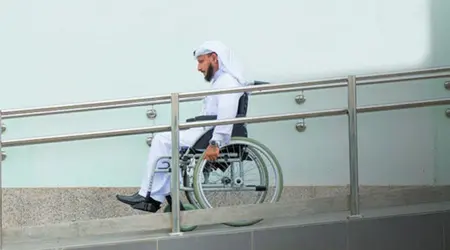
Why is Inclusive Infrastructure Becoming a National Priority?
The focus on Middle East Accessibility Policies has extended deep into the travel and tourism sectors, which are vital for economic growth.
Iconic projects like Dubai International Airport (DXB) are currently racing to become the world’s most accessible hubs by 2035.
These initiatives treat accessibility as a logistical challenge to be solved with innovation rather than an afterthought.
When a major airport installs over 520 hearing loops, it isn’t just a gesture; it is a fundamental upgrade to the travel experience.
How is Dubai Revolutionizing Air Travel for Everyone?
Dubai Airports launched a new phase of its strategy in late 2025, introducing “sensory-friendly” lounges and tactile guidance for visually impaired guests.
They have distributed over 35,000 Sunflower lanyards to help staff identify and assist passengers with hidden disabilities.
This comprehensive approach covers the entire journey, from check-in to boarding. By prioritizing comfort for those with sensory sensitivities, Dubai is setting a global benchmark for what inclusive transit should look like.
What is the Significance of Hearing Loop Technology?
The installation of hearing loops across 520 touchpoints at Dubai International is one of the largest such projects globally.
This technology allows travelers with hearing aids to receive clear audio directly from staff members, bypassing ambient terminal noise.
It serves as a practical example of “silent” inclusion that dramatically improves the lives of millions.
Can you imagine the relief of a traveler who can finally communicate clearly with immigration staff amidst a bustling crowd?
How Does Spatial AI Assist in Accessibility Planning?
Saudi Arabia’s Vision 2030 is leveraging AI and spatial data to map and improve accessibility in its rapidly growing “giga-projects.”
By 2025, 70% of Saudi strategic goals involve data-driven AI that helps identify and remove urban barriers. These “smart cities” are being built with accessibility in their DNA rather than being retrofitted later.
This proactive design philosophy ensures that the next generation of urban environments is inherently welcoming to every citizen.
Why is Universal Design More Than Just Ramps?
Universal design in the Middle East is evolving to include neurodiversity and invisible disabilities in its scope.
Policies now mandate noise-reducing seating and decompression zones in public spaces to support individuals with autism or anxiety.
This holistic view of accessibility recognizes that the environment affects everyone differently. It is an acknowledgment that a truly inclusive society must cater to the mind as well as the body.
What Do the Numbers Say About Regional Progress?

While the moral argument for Middle East Accessibility Policies is clear, the economic data is equally compelling.
Inclusion is increasingly recognized as a catalyst for GDP growth, especially as Gulf nations aim to maximize their local talent pools.
The World Bank’s 2025 reports indicate that disability-inclusive social protection projects in the region have increased by 75%.
This investment in the “care economy” is projected to reduce gender inequalities and bolster overall economic resilience.
What is the Economic Impact of Inclusive Hiring?
Data from the 2025 Disability Index Report reveals that 90% of regional organizations now have disability-focused resource groups.
This marks a steady rise from 87% in 2024, showing a deepening corporate commitment to diversity and inclusion.
These groups help companies identify internal barriers and foster a culture where diverse perspectives drive innovation.
In a competitive global market, the companies that embrace inclusion are the ones that see higher employee retention and better problem-solving.
How Does Accessibility Support Women in the Workforce?
A World Bank study released in September 2025 examined how inclusive childcare access affects the workforce participation of mothers with children with disabilities.
It found that removing accessibility barriers in childcare significantly increases maternal employment rates.
This research highlights the intersectionality of Middle East Accessibility Policies.
By supporting families with specific needs, these policies empower women to re-enter the labor market, driving further economic diversification.
What Analogy Best Describes the Current Change?
Think of Middle Eastern infrastructure like a grand orchestra that was previously missing its strings and percussion. The music was beautiful but incomplete, lacking the depth and resonance of a full ensemble.
The current shift toward accessibility is like the conductor finally inviting all the musicians to the stage.
By including everyone, the “economic symphony” becomes richer, more powerful, and far more representative of the entire community’s talent.
Is This a Slow Change or a Silent Revolution?
While some critics argue the pace of change is uneven, the legislative milestones of 2025 suggest a genuine revolution is underway.
The shift from “guidelines” to “laws with fines” is a definitive pivot point in regional governance.
The question is no longer if accessibility will happen, but how quickly the physical world can catch up to these ambitious new policies. Are we ready to witness a Middle East where every door is open to every citizen?
2025 Accessibility Policy Milestones in the Middle East
| Country | Major Policy/Law | Key Feature | Target Segment | Enforcement Status |
| Qatar | Law No. 22 of 2025 | Reasonable accommodations & quotas | Persons with Disabilities | Active (Enacted Oct 2025) |
| UAE | Digital Accessibility Policy | Standardized web/app access | People of Determination | Active (Updated 2024-25) |
| Oman | 2025 Employment Framework | 5% hiring quota & modifications | Qualified Workers with Disabilities | Phasing In (2025 rollout) |
| Saudi Arabia | Vision 2030 AI Strategy | AI-driven barrier mapping | Urban residents & tourists | Ongoing (Major 2025 focus) |
| Jordan | ICT for All (ITU 2025) | Digital literacy & standards | Regional ICT stakeholders | Collaborative (April 2025) |
In conclusion, Middle East Accessibility Policies in 2025 are no longer a peripheral concern but a core element of national development.
From the strict legal mandates of Qatar’s new disability law to the digital inclusive standards of the UAE, the region is proving that accessibility is a prerequisite for a modern, diversified economy.
This “silent revolution” is gradually dismantling the physical and digital barriers that once sidelined millions, replacing them with a framework of dignity and opportunity.
As infrastructure catches up with these ambitious laws, the Middle East is positioning itself as a global leader in inclusive urban design and public policy.
Which of these accessibility innovations do you think will have the biggest impact on daily life in your city? Share your experience in the comments!
Frequently Asked Questions
Does the new Qatari law apply to small private businesses?
Yes, Qatar’s Law No. 22 of 2025 applies to both public and private entities. While specific quotas might vary by company size, the requirement to provide “reasonable accommodation” and non-discriminatory hiring practices is universal across the labor market.
What is a “hearing loop” and why is it used at airports?
A hearing loop is an assistive listening system that transmits sound directly to hearing aids and cochlear implants.
In a noisy airport environment, it allows passengers with hearing loss to hear announcements or staff instructions clearly without background interference.
How can AI help with physical accessibility in cities?
AI can analyze vast amounts of urban data to identify where ramps are missing, where sidewalks are too narrow, or where public transport is inaccessible.
In Saudi Arabia, this data is used to optimize the design of “smart cities” before construction begins.
Is there financial support for businesses in Oman to become accessible?
Yes. Oman’s 2025 Inclusive Employment Framework includes incentives and support for workplace modifications.
This is designed to help employers cover the costs of making their offices and facilities accessible to employees with disabilities.
Why is digital accessibility suddenly such a high priority?
As government services move entirely online, a lack of digital accessibility becomes a form of “digital exile.”
Middle East Accessibility Policies now prioritize this because equal access to the internet is seen as a fundamental human right in a modern economy.
