
Public Bike-Sharing and Accessibility: Can It Be Inclusive?
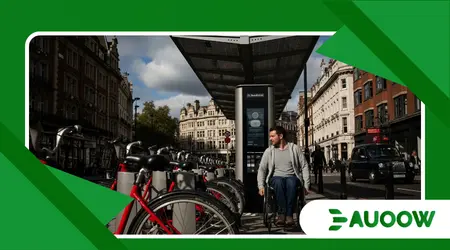
Early on a Tuesday morning in London, I watched Julian maneuver his wheelchair toward a sleek, solar-powered docking station.
Surrounding him were dozens of identical, cherry-red bicycles, symbols of a modern urbanity that promises seamless movement.
Julian, however, was not there to rent a bike; he was trying to reach the tactile paving located directly behind the heavy metal docking rack.
The very infrastructure designed to reduce carbon footprints had become a physical wall, cutting off the accessible path to the subway entrance.
This quiet, almost invisible friction point repeats in Paris, New York, and Bogotá. This specific tension regarding Public Bike-Sharing and Accessibility reveals a fundamental design paradox in our cities.
We often celebrate micro-mobility as a democratic triumph, yet we frequently build it upon the exclusion of those who cannot use a standard two-wheeled frame.
The sidewalk, once a shared public commons, is increasingly partitioned for tech-integrated transit that assumes a very specific type of able body.
Why does micro-mobility often ignore the disability community?
The expansion of bike-sharing programs usually follows a logic that rarely prioritizes universal design from the outset.
What rarely enters this debate is that these systems are often operated by private vendors under municipal contracts focused on high-volume turnover.
When the primary metric of success is the number of trips per hour, the specialized needs of riders with disabilities are sometimes dismissed as too expensive or niche.
There is a structural detail that cost-benefit analyses often ignore: the physical footprint of the docking stations.
In many historic cities, sidewalks are narrow, and adding a twenty-bike rack can reduce the “clear width” below accessibility standards.
This creates a scenario where a person with a mobility aid must choose between a dangerous street detour or a blocked path.
The irony is sharp; a system meant to democratize the city can end up tightening the boundaries for some residents.
++ Ride-Sharing Accessibility: Are Uber and Lyft Meeting Promises?
Can we move beyond the “standard” bicycle model?
When we observe with more attention, the pattern of exclusion repeats in the hardware itself.
Almost every major public fleet consists of the same upright, two-wheeled diamond frame that requires significant balance and core strength.
In my reading of this scenario, the lack of hand-cycles, trikes, or recumbent options isn’t always a technical limitation, but a failure of imagination.
If a city can maintain a fleet of thousands of electric bikes, it likely possesses the logistics to maintain adaptive equipment.
The challenge is often framed as a storage or “docking” problem, as hand-cycles are wider and heavier than standard bikes.
However, some cities have begun to prove that a hybrid model is feasible with the right policy focus.
Detroit’s MoGo program introduced an adaptive branch that offers various cycles for different physical needs. This suggests that inclusion isn’t an impossible feat; it simply requires moving past the aesthetic of uniformity.
Also read: The Rise of Electric Wheelchair Bikes for Urban Commuting
What are the barriers to adaptive fleet integration?
Maintenance remains a hurdle that municipal planners often cite when resisting the inclusion of adaptive bikes.
Unlike standardized frames, which use identical parts, trikes or hand-cycles may require specialized components and mechanical expertise.
This can create a secondary tier of service where the accessible option is more frequently out of commission compared to the main fleet.
Furthermore, the digital interface of the apps used to unlock these bikes is often not optimized for screen readers.
A blind user or someone with limited fine motor skills might find the “smart” lock entirely inaccessible.
When we talk about Public Bike-Sharing and Accessibility, we must look at the digital gatekeeping that occurs before a rider even touches the handlebars.
Read more: Inclusive Fashion Brands: Clothing Designed for Every Body
How does “dockless” technology impact sidewalk navigation?
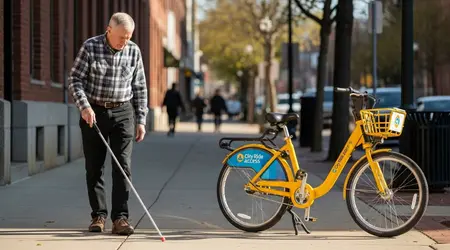
The shift toward dockless bikes those that can be parked anywhere introduced a new layer of difficulty for pedestrians with visual impairments.
A bike left lying across a walkway is a tripping hazard that a white cane might not detect in time.
While geofencing technology exists to encourage riders to park in designated zones, enforcement remains inconsistent across many urban jurisdictions.
Who is actually benefiting from the “green” transit revolution?
Legislation like the Americans with Disabilities Act (ADA) was meant to ensure that public services are open to everyone.
Yet, many bike-sharing programs operate in a legal gray area because they are often classified as private-public partnerships rather than core public transit.
This distinction sometimes allows operators to sidestep the stringent accessibility requirements that govern buses or light rail systems.
An honest analysis suggests that we may be witnessing a form of “transit disparity.”
We provide high-tech, subsidized options for the able-bodied “last mile” commute while leaving residents with disabilities to rely on aging or underfunded paratransit.
If the goal of Public Bike-Sharing and Accessibility is truly social equity, the investment should follow the need, not just the speed.
How can policy bridge the gap between innovation and inclusion?
Real change usually happens when accessibility is integrated into the procurement process from day one. Instead of asking for “a bike-sharing system,” cities could demand “a universal micro-mobility solution.”
This shift in language encourages vendors to include adaptive cycles as a condition of their operating license.
When accessibility is a requirement rather than an afterthought, the market often finds ways to innovate.
Imagine a worker with a mild balance disorder who cannot drive but could navigate a stable three-wheeled electric trike.
In the current model, this individual is often barred from the bike-sharing revolution and its associated cost benefits.
By diversifying the fleet, a city doesn’t just help a specific group; it expands the total pool of people who can opt out of car ownership.
Why is “Universal Design” the only path forward?
There is a good reason to question the approach of “separate but equal” adaptive hubs. When adaptive bikes are only available at one specific location, they remain a “special service” rather than a legitimate transit option.
True Public Bike-Sharing and Accessibility means Julian should be able to find an adaptive bike at the same corner where his neighbors find theirs.
Accessibility is sometimes viewed as a burden to be managed rather than a design standard to be embraced.
Yet, a city that is navigable for a wheelchair user is more navigable for a parent with a stroller or a traveler with heavy luggage. Inclusion is not a zero-sum game; it is an upgrade for the entire urban experience.
What actually changed after these interventions?
| City | Intervention | Social Impact |
| Detroit (MoGo) | Integrated adaptive trikes and hand-cycles. | Increased participation from seniors and riders with disabilities. |
| Portland (BIKETOWN) | “Adaptive BIKETOWN” dedicated rental hub. | High usage for recreational and therapeutic purposes. |
| London (Santander) | Improved docking station placement guidelines. | Reduced sidewalk obstructions and improved pedestrian flow. |
| San Francisco | Stricter dockless parking enforcement and fines. | Decrease in walkway hazards for the visually impaired. |
The intersection of Public Bike-Sharing and Accessibility is a litmus test for urban values.
If we build “smart” cities that only work for a narrow definition of the “normal” body, we are simply digitizing old barriers.
The goal should be a city where movement is a right, not a privilege reserved for the agile. By rethinking the sidewalk and the cycle, we can finally create a transit landscape that truly belongs to everyone.
How does the accessibility of micro-mobility in your own city compare to the ideals of universal design? Share your experience in the comments.
Frequently Asked Questions
Why can’t all bike-sharing docks include adaptive cycles?
Standard docks are designed for narrow tires and specific frame heights to maximize space. Including adaptive cycles often requires “flexible” zones that accommodate wider footprints and different locking mechanisms.
Are electric bikes easier for people with disabilities to use?
Many people with chronic pain or respiratory issues find e-bikes more accessible than traditional pedal bikes. The motorized assist lowers the physical barrier to entry for a significant portion of the population.
What should I do if a shared bike is blocking an accessible ramp?
Most cities have a non-emergency reporting line or a feature within the bike-sharing app to report parking violations. Companies can use these reports to fine irresponsible riders and keep walkways clear.
Does adding adaptive bikes make the system more expensive for everyone?
While the initial investment in specialized hardware is higher, it increases the total utility of the system. In the long run, inclusive systems can reduce the demand on more expensive, specialized paratransit services.
Can bike-sharing apps be used by people with visual impairments?
Many modern apps are compatible with screen readers, but poor color contrast or small buttons remain common issues. Inclusive design requires testing software with users who have diverse sensory and motor needs.
