
AI Coworkers and Accessibility: Help or Surveillance?
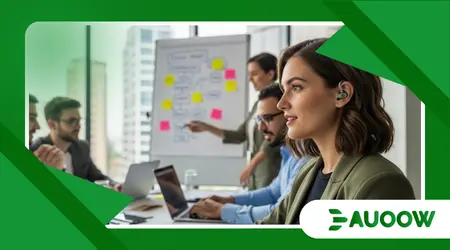
Imagine a software engineer named Sarah, who has been blind since birth, navigating a high-stakes sprint planning meeting where her AI Coworkers and Accessibility tools are active in her ear.
As her colleagues point to a shared digital whiteboard a visual tool often lacking screen-reader compatibility a synthetic voice narrates the spatial layout of the notes, allowing her to contribute in real-time.
For Sarah, this is the difference between being a peripheral observer and a core architect of the project.
Yet, as the AI summarizes her contributions, it also logs engagement metrics data points sent to a dashboard she cannot see.
The Changing Landscape of Workplace Inclusion
- The Digital Bridge: How generative agents are addressing longstanding gaps in corporate accessibility.
- The Privacy Paradox: Navigating the line between assistive data and performance monitoring.
- Policy Lag: Why traditional HR frameworks often struggle to keep pace with autonomous office assistants.
- Automated Accommodation: Examining the impact of machine-led support on workplace culture.
- The 2026 Perspective: Strategies for maintaining individual dignity in a machine-augmented environment.
Why are we integrating machines into human inclusion?
The shift toward incorporating autonomous agents into daily workflows is often framed as a triumph of efficiency.
However, a more grounded analysis suggests it is a response to persistent architectural failures.
Digital workspaces were rarely built with neurodiversity or physical disability in mind; they were designed for a specific “standard” user.
We are now using AI to address those historical oversights.
The potential of AI Coworkers and Accessibility lies in the ability to translate information in real-time converting complex spreadsheets into audio or simplifying chaotic video calls into high-contrast summaries.
There is a broader conversation about whether we are beginning to outsource the collective responsibility of empathy to algorithms.
In many modern firms, the task of ensuring a colleague can follow a presentation has shifted from the presenter to the colleague’s personal AI agent.
While this provides more individual autonomy, it also risks creating a siloed form of inclusion.
If technology handles every accommodation, a team might lose the vital habit of considering accessibility as a shared social responsibility.
++ Algorithmic Ableism: How Productivity Software Penalizes Disabled Workers
How do digital assistants support disabled professionals?
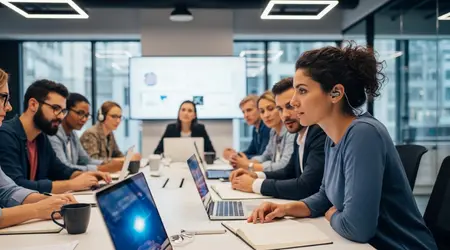
Consider a project manager with ADHD who uses a “Co-pilot” agent to filter a high-volume Slack channel.
The agent does more than notify them of mentions; it recontextualizes conversations, highlighting action items and suppressing distractions.
This represents a significant shift in daily accessibility, where the machine acts as a cognitive aid for executive function tasks that previously led to burnout.
In this context, technology is helping to level a professional field that has been uneven for generations.
A structural detail that warrants attention is the proprietary nature of these tools. Most advanced assistive agents are tied to specific corporate ecosystems.
If a professional becomes reliant on a specific AI Coworkers and Accessibility suite to perform their job, their professional mobility may become tethered to that software.
This creates a form of “lock-in” where accessibility functions like a subscription service, raising questions about who owns the bridge between a professional and their work.
What has shifted since the 2025 integration wave?
| Feature | Traditional Accommodation (Pre-2025) | AI-Driven Accessibility (2026) |
| Response | Reactive: Requested and then approved by HR. | Proactive: Real-time adaptation by the system. |
| Nature | Static: Specific hardware or physical tools. | Fluid: Dynamic speech-to-text and filtering. |
| Visibility | Visible: Often requires obvious adjustments. | Integrated: Part of the standard software stack. |
| Mediation | Human-Mediated: Relies on a colleague. | Agent-Mediated: Relies on a digital coworker. |
Is assistive support also a tool for workplace monitoring?
There is reason to look closely at how these technologies are implemented. Every time an assistive AI transcribes speech or organizes a calendar, it generates behavioral metadata.
For a professional with a disability, the data required to facilitate accessibility is often personal. It may reflect processing speeds, fatigue patterns, or specific needs.
Without strict data firewalls, accessibility tools could inadvertently become intrusive monitoring devices.
In 2026, performance analytics dashboards frequently draw data from these assistive agents.
If a system notes that a professional takes longer to process a specific report even if they are a high performer that data point is recorded.
When AI Coworkers and Accessibility are discussed alongside workforce optimization, we must consider whether the tool is serving the individual or if the individual’s performance is being harvested to refine the tool.
For some, the trade-off for accessibility is a significant loss of digital privacy.
Also read: Digital Freelancing: A Game-Changer for Disabled Professionals?
Why does data logging impact different groups uniquely?
Monitoring is rarely experienced equally across a workforce.
For people with disabilities, who have often had to provide extensive documentation to justify their presence in certain roles, the constant logging of an AI coworker can feel restrictive.
If an employee uses a voice-control agent due to a mobility impairment, the system potentially captures every background sound and pause in their environment.
The pattern is often that those who require the most support from technology are subjected to the most intense observation.
The push for AI Coworkers and Accessibility should ideally be accompanied by a focus on digital rights.
This is not just about privacy regulations; it is about ensuring that an individual’s assistive needs are never used as a metric for their professional worth during a performance review.
Balancing assistive innovation and environmental design
Some organizational decisions prioritize tools that adapt the individual to the environment rather than fixing the environment itself.
It is often less expensive to provide an AI license than to rebuild a legacy database to be universally accessible.
This can create a patchwork culture where technology is used to bypass barriers that should have been removed.
This approach places the weight of accessibility on the individual’s digital agent. Genuine inclusion occurs when an environment is designed for everyone from the outset.
However, the speed of AI development means that waiting for universal design in the physical world might take too long for those who need support now.
For many, the AI coworker is a vital, if imperfect, resource for professional participation.
Read more: Robotics and Automation: Threat or Opportunity for Disabled Workers?
Toward a future of integrated accessibility
Imagine a neurodivergent employee joining a video call where their AI Coworkers and Accessibility agent automatically manages audio frequencies and provides a real-time summary of the discussion’s tone.
To the rest of the team, the process is invisible. The employee feels supported and productive.
This seamless integration is the goal of assistive technology making the specific needs of an individual irrelevant to the quality of the work they produce.
A deeper analysis requires looking at the conditions of that support. If data from these agents is shared with management to monitor team morale, the professional has inadvertently become a sensor for the organization.
We are currently at a point where we must decide if the AI coworker is a private assistant or a corporate reporting tool.
Autonomy suggests that the user should have granular control over what the agent remembers and what it shares.
Defining Human-Centric Inclusion
The path for AI Coworkers and Accessibility is found not just in more complex code, but in stronger ethical frameworks.
This technological shift has the potential to remove barriers for millions of individuals. However, we must ensure that we aren’t replacing physical obstacles with digital ones.
Genuine accessibility is about the right to perform work with dignity, privacy, and autonomy.
As we integrate these synthetic colleagues into our workplaces, the goal is to ensure they function as allies.
Inclusion is most effective when technology respects the full spectrum of the human experience without making performance metrics the primary focus.
FAQ: Navigating AI and Accessibility Rights
1. Can an employer mandate the use of a specific AI tool for accommodation?
Under many labor laws, professionals have a right to reasonable accommodation.
While an employer can suggest an AI tool, they generally cannot mandate a specific technology if it compromises an individual’s privacy or does not effectively meet their needs.
2. Is data from assistive AI protected by health privacy laws?
In most office settings, productivity data is governed by employment contracts and general privacy laws rather than specific medical privacy regulations.
This remains a significant legal area for refinement in 2026.
3. Does using an AI agent impact how professional capability is perceived?
The goal is to move toward universal tools that the entire team uses.
When everyone uses a digital assistant, the fact that one is configured for cognitive support or a screen reader becomes less prominent, which may help reduce social stigmas.
4. How can I identify if an assistive tool is also logging performance data?
Review the permissions and data-sharing agreements. If a tool requires administrative access to a company’s central analytics platform, it is likely reporting usage patterns to a central database.
5. Are there privacy-focused assistive AI options?
Yes, some assistive agents process data locally on the device rather than in the cloud.
These models offer higher privacy for sensitive workplace interactions, though they may have different processing capabilities than large-scale cloud models.
