
How accessible EV charging stations lag behind urban demand
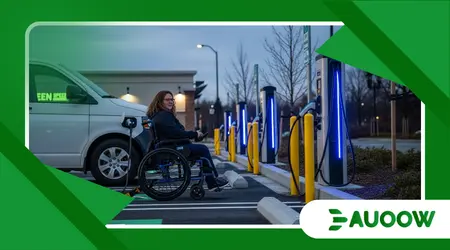
The deployment of accessible EV charging stations often feels like an afterthought in the race toward a greener urban landscape.
Picture Sarah, a high school teacher in Seattle who drives a customized van equipped with a side-entry wheelchair lift.
Recently, she pulled into a new “green” parking zone at a local shopping center, finding a row of high-speed chargers glowing with blue LED lights.
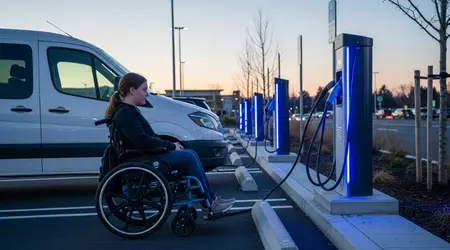
As she approached, the physical barriers became clear. The charger was mounted on a high concrete curb, surrounded by narrow bollards that made it impossible for her to lower her ramp.
Even if she could have exited the vehicle, the charging cable was heavy and positioned five feet above the ground well beyond the reach of a person using a wheelchair.
Sarah sat in her van, watching the battery tick down, realizing the “future of transport” had been designed without her in mind.
The Landscape of EV Infrastructure
- The Physical Gap: Why standard charging designs physically exclude drivers with mobility impairments.
- Legislative Lag: The disconnect between established accessibility standards and new green energy mandates.
- Technical Barriers: Addressing cable weight, screen height, and payment interfaces.
- Urban Demand vs. Inclusion: How rapid deployment often sacrifices universal design for speed.
Why are we repeating old mistakes in new infrastructure?
It is a striking contradiction. We are in the midst of a multi-billion dollar overhaul of the global fueling network, yet we see the same architectural exclusions that were supposedly addressed decades ago.
The rush to meet aggressive carbon-reduction targets has fostered a “compliance-only” culture. Developers often focus on the quantity of plugs in the ground rather than the quality of access to those plugs.
A significant issue is the assumption that EV drivers are a monolithic group of able-bodied early adopters.
There is a structural detail that is often ignored: by the time regulations catch up to the technology, thousands of inaccessible units will have already been bolted into the concrete.
We tend to prioritize the machine’s requirements cooling, voltage, and safety over the human’s ability to interact with it.
++ Why QR code menus accessibility still fails blind users today
How accessibility laws impact today’s charging networks
While broad legislation provides an umbrella for public accommodations, it often lacks the specific technical standards required for high-voltage charging equipment.
In 2022, the U.S. Access Board released technical assistance on accessible EV charging stations, but these are frequently treated as “best practices” rather than strictly enforced requirements in many jurisdictions.
There is also the legacy of the “gas station” model. Historically, an attendant or family member could assist at the pump.
However, EV charging is designed to be autonomous and unstaffed.
When you remove the human element of service, the physical interface must be intuitive and accessible. If it isn’t, the result isn’t just an inconvenience; it is a barrier that can leave a person stranded.
What changed after the 2022 Access Board recommendations?
While the recommendations provided a blueprint, implementation across urban centers remains erratic.
There is a meaningful difference between a charger that is technically “reachable” and one that is truly usable in a real-world scenario.
| Accessibility Feature | Standard Charging Station | Accessible Standard (Goal) | Impact |
| Clear Floor Space | Often obstructed by bollards. | 30″ x 48″ minimum clearance. | Allows for wheelchair maneuvering. |
| Operable Parts | Located 48″ to 60″ high. | Max 48″ high for all controls. | Ensures reachability for all users. |
| Cable Management | Heavy, ground-trailing cables. | Retractable or balanced cables. | Reduces physical strain. |
| Bollard Placement | Narrow, protecting the unit. | Wide enough for van ramps. | Facilitates safe vehicle exit. |
| Payment Interface | High-mounted screens. | Low-angle, high-contrast. | Facilitates independent use. |
The change has often been cosmetic. We see a few blue-painted spots, but the fundamental ergonomics of the charging pedestal frequently remain unchanged.
There is a reluctance to rethink the pedestal design because mass-manufacturing a single, non-adjustable unit is seen as more cost-effective than designing for diversity.
The heavy charging cable: A silent barrier to independence
Consider a professional who uses a manual wheelchair.
They may have the strength to drive and work, but lack the leverage to wrestle a liquid-cooled, high-speed DC fast-charging cable that can weigh thirty pounds.
These cables are often short and stiff to manage heat, but for someone with limited reach or grip strength, they can be nearly impossible to manage.
Engineering priorities have historically focused on thermal management over human factors. As we move toward faster charging, cables are becoming thicker.
Without mechanical assistance or a redesign of the plug interface, we risk telling a large segment of the population that long-distance travel is not for them.
This erodes the independence that the automobile is meant to provide.
Also read: Toothbrush Tech for Disabled Users: The Rise of Y-Brush and Alternatives
Urban density and the rollout of inclusive charging
In dense cities, space is a luxury. When a municipality installs curbside charging, they balance needs for bike lanes, dining, and parking.
In this environment, the extra width required for an accessible aisle is often the first thing sacrificed.
This approach is shortsighted. By opting for “compact” charging zones, cities may lock in a future where disabled residents must rely on expensive private charging hubs or are unable to switch to electric vehicles at all.
This creates a “disability tax” on the green transition, where a lack of public access forces individuals into costlier private alternatives.
Read more: Cleaning Made Easy: Accessible Vacuum and Robot Solutions
The role of technology in solving the accessibility gap
We often look to robotic arms or wireless inductive charging as the future of accessible EV charging stations. While these are promising, they are not yet ubiquitous or affordable.
Relying on “future tech” can sometimes serve as an excuse to avoid making common-sense changes to today’s hardware.
The most effective assistive technology is often a longer cable, a lower screen, and a wider parking bay.
Universal design benefits everyone: a lighter cable is easier for an elderly driver or someone with a temporary injury to handle.
A lower screen is easier for most people to see in bright sunlight. When we design for the margins, we improve the experience for everyone.
Can policy mandates catch up to urban demand?
Infrastructure grants need specific requirements to ensure progress. Currently, significant funding is being directed into EV networks.
If this funding were strictly contingent on meeting universal design standards, the industry would likely pivot quickly.
The private sector often follows the path of least resistance until the alternative is made legally or financially necessary.
Some regions are beginning to tie carbon credits and grant eligibility to accessibility metrics. This shifts the conversation from one of “charity” to one of compliance and market necessity.
The Ethical Imperative of the Green Transition
The transition to electric vehicles is a social shift as much as a technological one. If we build a world that is cleaner but less inclusive, we have missed the mark on true progress.
Accessible EV charging stations are a litmus test for our commitment to universal design in this century.
We cannot wait for the next generation of infrastructure. The concrete is being poured now. If we don’t ensure these spaces belong to everyone, we are intentionally designing a future that excludes.
Inclusion is a prerequisite for a truly modern society. Let us ensure the electric future is accessible to everyone, regardless of how they move through the world.
Frequently Asked Questions
Are all Tesla Superchargers ADA compliant?
Not all. Tesla has begun adding specific stalls with more space and lower pedestals in newer stations. However, many older stations are built on high curbs with tight spacing, which can be difficult to navigate independently.
Can I request assistance at a public EV charging station?
Most public stations are unstaffed. While apps may have a “help” button, this usually connects to a remote agent who can troubleshoot the software but cannot physically help plug in the cable.
Is wireless charging the future for accessible EVs?
Wireless (inductive) charging would remove many physical barriers. However, it is currently less efficient and requires specific hardware on both the ground and the vehicle.
Why are charging cables so short and heavy?
High-speed chargers generate heat; short cables minimize energy loss. The weight often comes from liquid cooling systems inside the cable.
How do I find accessible EV charging stations?
Apps like PlugShare have added filters for accessibility. Since these often rely on user-generated data, it is helpful to check photos of the location to verify the layout.
