
How AI in inclusive education is reshaping classrooms in 2026
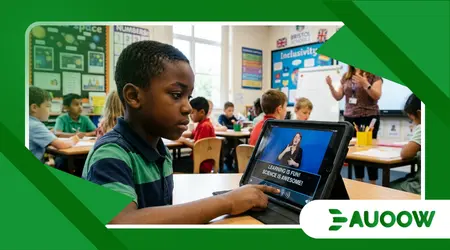
The promise that AI in inclusive education is reshaping classrooms in 2026 is perhaps best understood not through a press release, but through the quiet focus of a ten-year-old named Leo.
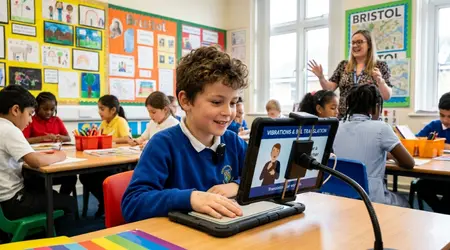
Leo sits in a vibrant primary school in Bristol, his eyes tracking a digital tablet that translates his teacher’s spoken words into real-time, simplified sign language and haptic vibrations.
Five years ago, Leo would have spent half his energy simply trying to decipher the “vibe” of the lesson, constantly looking at his peers for cues he couldn’t hear.
Today, the technology doesn’t just assist him; it dissolves the invisible glass wall that once stood between him and the curriculum.
What we are witnessing is a fundamental shift in how we perceive the “average student.” For decades, classrooms were designed for a mythical middle a standard learner who moved at a specific pace.
Anyone outside that bell curve was “accommodated,” a term that often signaled an afterthought.
Now, the integration of intelligent systems is prompting a long-overdue reckoning with the very structure of learning.
Inside the 2026 Inclusive Classroom
- The End of the Mythical Average: How adaptive platforms prioritize individual neurodiversity over standardized pacing.
- Sensory Translation: The rise of real-time audio-to-visual and text-to-tactile tools for sensory impairments.
- Predictive Support: Identifying cognitive fatigue before a student reaches a point of frustration.
- The Teacher’s New Role: Moving from content delivery to emotional and social orchestration.
Why did it take a technological leap to fix a social barrier?
The history of inclusive education is marked by well-intentioned policies that frequently faltered because they lacked the practical means to be implemented.
Teachers, regardless of their dedication, cannot be twenty different versions of themselves for twenty different students at once.
This is where AI in inclusive education is reshaping classrooms in 2026, acting as a personalized bridge that functions at the speed of thought.
There is a structural detail that often gets ignored: the cost of human-led intervention.
Traditionally, if a student needed a personalized lesson plan, it required extensive administrative labor or a specialized assistant.
This scarcity of resources meant that “inclusion” was often just “integration” putting a child in the room without giving them the keys to the conversation.
We spent years trying to make the student fit the classroom. Now, the classroom is finally being coded to fit the student. The barrier wasn’t a lack of empathy; it was a lack of scalable flexibility.
++ Teachers’ intention to adopt AI for inclusive education in the UAE
How does real-time adaptation change the student’s psyche?
The most profound change isn’t the software itself, but the student’s sense of agency.
When a student with dyslexia uses an AI-powered camera that instantly adjusts the text of a physical book into an “OpenDyslexic” font, the weight of being “slow” begins to evaporate.
The focus shifts from the struggle to the content. This is a crucial distinction. We are no longer testing a student’s disability; we are finally engaging with their intellect.
This shift in the internal narrative of the student is a subtle, yet powerful, social transformation.
There is a quiet revolution in the absence of the “hand-raise.” A student who navigates social anxiety or verbal processing can now interact with a lesson via a non-verbal interface that interprets their progress without the public pressure of a spotlight.
The classroom becomes a safer space for cognitive diversity.
What happens when the curriculum becomes “liquid”?
The concept of a static textbook is essentially dead. The way AI in inclusive education is reshaping classrooms in 2026 involves the creation of “Liquid Curriculums.”
Imagine a history lesson that automatically adjusts its complexity based on a student’s reading level, while maintaining the same core conceptual goals.
One student might be reading a complex narrative of the Industrial Revolution, while another receives the same information through an interactive 3D model with simplified captions.
They are learning the same history, at the same time, in the same room.
The traditional “one-size-fits-all” model was a product of the industrial era, designed to produce uniform workers.
Today’s technology is finally allowing us to move past that mold, honoring the fact that human intelligence is naturally diverse and multifaceted.
Also read: Standardized Testing vs Inclusive Assessment: What Works Better?
Is the human teacher being replaced or reinforced?
A common fear is that we are handing our children over to algorithms. However, current trends suggest the opposite.
By automating the mechanical tasks of translation, transcription, and basic grading, teachers are being freed to do what they do best: mentor, inspire, and provide emotional support.
The teacher in 2026 is less a broadcaster and more a conductor.
They oversee a symphony of different learning modes, intervening when the data shows a student is emotionally disengaged or hitting a psychological wall that no software can climb.
There is an ethical nuance here that we must watch closely. The AI can tell us how a student is learning, but it cannot tell us why they are crying.
The human element remains the soul of the classroom, but it is now a soul that is no longer burnt out by impossible administrative demands.
Read more: The Role of Peer Support in Inclusive Education
How do we ensure the “Digital Divide” doesn’t become a “Disability Divide”?
The most honest assessment of this progress requires us to look at who is left behind. While high-income districts are seeing these benefits, rural schools and developing nations still struggle with basic internet connectivity.
If AI in inclusive education is reshaping classrooms in 2026 only for the wealthy, we are simply digitizing inequality.
We run the risk of creating a world where accessibility is a premium feature rather than a fundamental right.
There is also the question of data privacy. Students with disabilities often generate more sensitive data behavioral patterns, eye-tracking metrics, and speech samples. We must ask who owns this data and how it is protected against future discrimination.
Auoow’s Reality Check: What actually changed?
| The Old Way (2020) | The New Way (2026) | Social Impact |
| Fixed Content: One textbook for all. | Adaptive Content: Real-time level adjustment. | Reduced dropout rates for neurodivergent pupils. |
| Delayed Support: Waiting for a specialist. | Immediate Support: On-demand AI assistance. | Increased student confidence and autonomy. |
| Reactive Inclusion: Fixing problems after failure. | Proactive Inclusion: Predicting barriers via data. | Less emotional trauma for students with SEND. |
| Physical Constraints: Limited to school hours. | Ubiquitous Access: Learning tools travel home. | Parents are better equipped to support their children. |
Why are we finally moving past “The Medical Model” of disability?
For a century, education viewed disability as a “problem” within the child that needed to be “fixed.” The current technological shift supports the “Social Model” the idea that disability is created by an inaccessible environment.
When a student uses a neuro-interface to type, the “problem” isn’t their inability to hold a pen; the problem was the pen itself.
By changing the tools, we change the definition of capability. This is the heart of why AI in inclusive education is reshaping classrooms in 2026.
The pattern repeats in every sector. When we design for the margins, we often find that the results benefit everyone.
Text-to-speech was designed for those with visual impairments, yet it is now a staple for the multitasking professional. Inclusive AI is no different; it is creating a more flexible world for all learners.
What is the role of the parent in this new ecosystem?
Imagine a parent who, for the first time, receives a weekly report that doesn’t just list grades, but explains their child’s “engagement peaks.”
They learn that their daughter thrives on visual storytelling but faces challenges with abstract algebra on Tuesday mornings.
This level of insight allows for a more empathetic home life. Instead of a battle over homework, there is a conversation about strategy.
The wall between the school and the home becomes semi-permeable, allowing for a consistent support structure that follows the child.
When parents are no longer in the dark about how their child learns, the pressure on the family unit decreases. The school stops being a source of stress and starts being a partner in the child’s development.
Reimagining the Architecture of the Human Mind
The evolution of the classroom is ultimately a mirror of our social values. When we invest in the idea that AI in inclusive education is reshaping classrooms in 2026, we are making a statement about the worth of every individual.
We are deciding that a child’s potential should not be limited by the medium through which they receive information.
The path forward requires us to be as vigilant as we are excited. We must guard against algorithmic bias and ensure that the digital tools we build are infused with human ethics.
But the sights and sounds of a modern classroom the quiet hum of adaptive devices and the diverse ways of participating suggest we are on the right track.
The goal was never to create a perfect school. It was to create a school where every child feels that the room was built with them in mind.
By embracing the complexity of the human mind through the precision of technology, we are making that room a reality.
If you have seen these changes in your own local school, or if you have concerns about the direction of digital inclusion, I invite you to share your perspective. The conversation about our children’s future is too important to be left to technologists alone.
Frequently Asked Questions
Will AI replace the need for special education teachers?
Absolutely not. AI handles the “what” and “how” of content delivery, but special education teachers provide the “why” and the emotional regulation that students need.
These educators are more essential than ever as they transition into roles as inclusion architects.
Is this technology only for students with diagnosed disabilities?
No. One of the greatest benefits of the 2026 classroom is that these tools are available to everyone.
A student who is struggling with a specific concept can use adaptive tools without needing a formal medical label, reducing the stigma of seeking help.
How do schools handle the privacy of students’ behavioral data?
This is a major debate. Most leading systems now use “Edge AI,” where data is processed locally on the student’s device rather than a central cloud.
However, parents should always check their district’s data sovereignty policies.
Doesn’t this make students too dependent on technology?
The goal isn’t to create dependency, but to provide a “cognitive ramp.”
Just as a wheelchair doesn’t make someone “dependent” but rather gives them the freedom to move, AI gives students the freedom to think and participate.
How can underfunded schools afford these AI systems?
While initial costs are significant, the long-term savings in administrative labor and the reduced need for expensive external specialists are making a strong financial case for government investment in these platforms as a standard public utility.
