
How smart city accessibility affects everyday urban independence
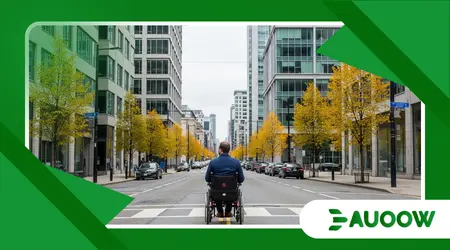
The morning commute in a revitalized tech corridor of Seattle or London doesn’t start at the office door; it begins the moment a person leaves their home.
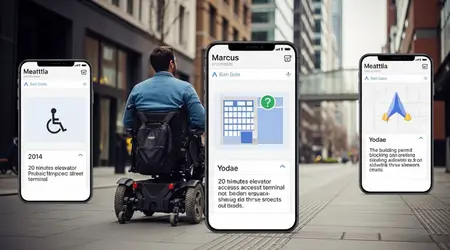
For Marcus, a software engineer who uses a power wheelchair, the success of his day depends on a silent, digital choreography.
In 2014, he might have spent twenty minutes scouting curb cuts on Google Street View, hoping the imagery was current.
Today, his city’s open data platform communicates directly with his navigation app, flagging a broken elevator at the transit hub and a construction permit blocking the sidewalk three blocks ahead.
This seamless integration of data and physical space illustrates how smart city accessibility affects everyday urban independence in the mid-2020s.
- Predictive Navigation: Moving from reactive searching to real-time barrier alerts.
- The Digital Twin Dilemma: Addressing why virtual models of cities often overlook the “human friction” of disability.
- Public Policy vs. Private Tech: The effort to standardize accessibility in proprietary applications.
- The Right to the Curb: How the competition for sidewalk space defines the future of urban mobility.
Why does a “smart” city still present barriers for many?
There is a recurring irony in urban planning. We are told the “City of the Future” will be a frictionless marvel of IoT sensors and automated shuttles.
However, for a significant portion of the disability community, the initial rollout of these technologies often created new hurdles.
Municipal transitions over the last two decades have frequently prioritized hardware shiny new kiosks or sleek electric scooters rather than the underlying logic of inclusion.
The conversation rarely addresses “data poverty.” A smart city is only as inclusive as the data it collects.
If a city’s digital map tracks bike lanes but ignores the incline of a ramp or the texture of tactile paving, it is essentially building a two-tier reality.
When we look closer at how smart city accessibility affects everyday urban independence, we see that real progress isn’t found in the gadgets themselves.
It is in the transition from “static” accessibility (installing a ramp) to “dynamic” accessibility (knowing if that ramp is currently blocked by a delivery truck).
++ Why Most Assistive Hardware Never Makes It Past the Pilot Phase
How real-time data changes the psychology of movement
For a person with a mobility impairment or a sensory disability, a significant drain on independence isn’t just the physical effort; it is the cognitive load of uncertainty.
Every journey involves a series of variables. Is the bus lift functional? Is the accessible entrance unlocked?
When a city integrates high-fidelity, real-time sensors into its infrastructure, it begins to offload that cognitive burden.
There is a structural detail that planners sometimes overlook: the difference between “compliance” and “usability.”
A train station might be legally compliant with accessibility standards, but if the only working elevator is a half-mile detour from the main flow of traffic, the “smart” solution hasn’t met the user’s needs.
Independence can be measured in time. If a disabled resident must spend significantly longer to navigate the same distance as a non-disabled peer, the city remains structurally exclusionary, regardless of how many sensors are installed.
Urban Mobility Standards: 2024 to 2026
| Feature | Pre-2024 Reality | Post-2026 Implementation |
| Sidewalk Monitoring | Manual reports; long delays for repairs. | AI-driven monitoring and instant app alerts. |
| Public Transit | Visual signs often lacking audio alternatives. | Haptic feedback and precise audio cues. |
| Parking | Searching for accessible spots in person. | Real-time sensors and remote reservation options. |
| Emergency Alerts | Generic sirens or text-only messages. | Multi-modal alerts (visual, haptic, and simplified text). |
Is the “Digital Twin” the secret to inclusive planning?
Architects and city planners increasingly use “Digital Twins” 3D virtual replicas of cities used to simulate traffic and energy use. This is where a profound shift is occurring.
By using these models, planners can simulate how a person with low vision or a wheelchair user experiences a new plaza before construction begins.
However, “algorithmic bias” remains a risk. If a simulation doesn’t account for the weight of a heavy door or the glare of a glass wall on a guide dog’s eyes, the virtual model lacks practical value.
We risk swapping physical barriers for digital oversights. When observing how smart city accessibility affects everyday urban independence, we must consider who is designing these simulations.
Without the lived experience of disabled engineers and consultants, the digital twin may simply replicate existing blind spots in a high-tech format.
Navigating invisible barriers in professional life
Imagine a professional with a sensory processing disorder navigating a “smart” transit terminal.
The environment is filled with flashing LED advertisements, high-pitched acoustic sensors, and automated gates requiring precise timing.
On paper, the station is a marvel of engineering. In reality, it can be a sensory minefield.
The issue isn’t the technology, but the lack of user-controlled environments.
A truly smart city would allow a commuter to use an app to adjust their sensory input perhaps by suggesting a quieter route or allowing for a slower pace at the turnstiles.
This level of personalization represents the next frontier of independence, moving beyond the idea of “fixing” the person and focusing on making the environment elastic enough to accommodate everyone.
Also read: The Rise of Electric Wheelchair Bikes for Urban Commuting
Sidewalk friction and the threat to autonomy
The sidewalk is some of the most contested real estate in any city. Pedestrians, delivery robots, e-scooters, and outdoor dining pods all compete for space.
For someone using a white cane or a wheelchair, these innovations often feel like an obstacle course.
This raises an ethical question: do we prioritize the “frictionless” delivery of goods over the basic right of a citizen to move safely through their neighborhood?
We are currently in a formative phase of urban tech. While some cities use sensors to manage e-scooters parked incorrectly, others allow private interests to dictate curb use.
This is where smart city accessibility affects everyday urban independence most directly.
If “smart” technology actively degrades accessible infrastructure, the result is a privatization of barriers rather than a move forward.
Read more: Inclusive Fashion Brands: Clothing Designed for Every Body
Toward universal urban design
The goal for urban policy must be the move toward Universal Design in its digital form.
This means accessibility features are not “add-ons” for a specific group, but core functionalities that benefit everyone.
A curb cut helps a person in a wheelchair, a parent with a stroller, and a traveler with a suitcase.
Similarly, high-quality audio navigation assists the blind traveler as well as the visitor who doesn’t speak the local language.
There is a risk that the digital divide could become a permanent fixture. If the “smart” features of a city require the latest expensive smartphone to access, independence is effectively gatekept.
True urban resilience is found in the reach of empathy and the affordability of tools. The “invisible grid” supporting our movements should be a public utility, not a premium service for a few.
The Ethics of the Next Horizon
The test of an urban revolution is not how many tasks a city can automate, but who is included once the transition is complete.
The conversation around how smart city accessibility affects everyday urban independence must shift from a focus on efficiency to a focus on humanity.
Human diversity is not a “bug” in the system to be smoothed out for an algorithm. True resilience is found in the reach of our empathy.
By integrating the lived experience of the disability community into the DNA of urban strategies, we can create a world that isn’t just more efficient but one that is truly accessible to all.
The city may be the machine, but the human must remain the purpose.
FAQ: Navigating the Accessible Smart City
1. Does “smart city” technology replace the need for physical ramps and elevators?
No. Digital tools can identify where a ramp is or if an elevator is working, but they cannot replace physical infrastructure.
Technology is a layer that makes existing access more predictable and efficient.
2. How do smart cities protect the privacy of disabled users?
This is a significant concern. Secure cities utilize anonymized data aggregation.
The system may recognize that a wheelchair user is at a crossing to adjust signal timing without identifying the specific individual.
3. Are these technologies available in smaller towns?
Currently, a gap exists. Large metros often have larger budgets for IoT sensors, but smaller towns are increasingly adopting low-cost solutions, such as QR codes at bus stops that provide real-time audio schedules.
4. How can I report an accessibility issue in a smart city?
Many cities now offer digital portals or apps where users can drop a GPS pin and upload a photo of a barrier.
These systems are increasingly linked to automated repair schedules to improve response times.
5. Is AI helping with urban accessibility?
Yes. AI is being used to analyze street-view imagery to automatically map missing curb cuts or narrow sidewalks, helping municipalities prioritize their maintenance and construction budgets.
