
Railway Accessibility Laws vs Reality: A Global Comparison
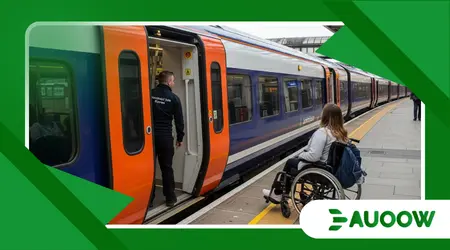
The quiet, ritualistic anxiety of a traveler waiting at a London station offers a stark window into the friction between Railway Accessibility Laws vs Reality.
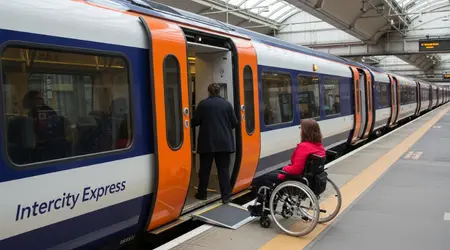
Imagine Sarah, a professional who relies on her manual wheelchair, positioned at the edge of a platform in Paddington.
She has followed every protocol: she booked assistance 24 hours in advance and received her confirmation.
Yet, as the Intercity express pulls in, the gap between the platform edge and the carriage door remains an impassable chasm.
The staff member with the ramp is missing. Sarah watches the doors hiss shut as the train departs, taking her schedule and her autonomy with it.
This is not a relic of the past; it is a Tuesday morning in 2026. Despite decades of high-level legislation and “inclusive” branding, the world’s railway networks remain stubborn bastions of exclusion.
Inside the Analysis
- Global Legislation: Examining the ADA (USA), the European Accessibility Act, and Japan’s Barrier-Free Law.
- Structural Conflict: Why 19th-century Victorian engineering still dictates 21st-century mobility.
- The Human Factor: The inherent failure of “assisted travel” as a substitute for autonomous design.
- Regional Variance: Comparing the high-tech seamlessness of Tokyo with the infrastructure of New York and Paris.
Why does the gap between laws and platforms persist?
When we analyze the chasm in Railway Accessibility Laws vs Reality, the issue extends beyond funding. It is a conflict between deep-seated history and modern ethics.
Most major rail hubs were designed in an era when people with disabilities were largely sequestered from public life.
Victorian engineers prioritized the movement of steam and masses, not the nuanced ergonomics required for a wheelchair or a white cane.
We are essentially trying to retrofit dignity onto systems that were architecturally indifferent to it.
A critical structural detail often overlooked involves “grandfathering” clauses. In many jurisdictions, laws like the Americans with Disabilities Act (ADA) only mandate full accessibility during “major renovations.”
This creates a perverse incentive for transit authorities to patch old stations with temporary fixes rather than embarking on the systemic overhauls required for true inclusion.
++ Accessibility in Infrastructure Megaprojects: Who Is Left Out?”
Railway Accessibility Laws vs Reality: A Global Summary of Social Impacts
| Region | Key Legislation | The “Reality” Gap | Social Impact |
| United States | ADA (1990) | Only ~25% of legacy NYC subway stations are fully accessible. | Severe limitations on employment and social participation. |
| European Union | EAA (2019/2025) | High variance between modern hubs and rural “halt” stations. | Fragmentation of the “Right to Roam” across borders. |
| Japan | Barrier-Free Law (2000/2020) | High physical accessibility; challenges in rural staff assistance. | High levels of independent mobility for elderly and disabled citizens. |
| United Kingdom | Equality Act (2010) | Reliance on “Turn up and Go” which frequently fails due to staffing. | Significant travel anxiety and loss of spontaneous agency. |
Is high-tech infrastructure enough for true inclusion?
There is a tendency in policy circles to assume a new elevator solves the problem. However, the issue is often more granular. Consider a traveler with a visual impairment navigating Gare du Nord in Paris.
Laws mandate tactile paving, but if that paving is interrupted by a pop-up kiosk or a pile of luggage, the law becomes a trap.
Accessibility is often treated as a “project” with a start and end date, rather than an ongoing operational requirement.
The maintenance of accessibility features is rarely funded at the same level as their installation.
An elevator out of service for “routine maintenance” for three weeks is not an accessible feature; it is a vertical wall.
For many rail operators, priority remains on “on-time performance,” and if that means bypassing a person who needs a ramp to keep the schedule, the system defaults to exclusion.
Why does Japan succeed where others struggle?
In Tokyo, the Railway Accessibility Laws vs Reality seem to align more closely than anywhere else. The difference isn’t just a larger budget; it is a cultural shift in how public space is perceived.
In Japan, the “Barrier-Free” philosophy was integrated into urban renewal projects as a necessity for an aging society, not just a legal burden.
When you design for a person in a wheelchair, you also design for a parent with a stroller or an older adult with a heavy suitcase.
While Western approaches often treat accessibility as a “special interest” niche, Japan treats mobility as a universal human right engineered into the floorboards.
This seamless transition from street to Shinkansen is the result of intentional, universal engineering.
Also read: Why Assistive Technology Funding Rarely Reaches End Users
How do decisions from the 19th century affect us today?
Whenever we discuss the modern failure of a station in Philadelphia or Berlin, we must connect past decisions with current practices.
In the mid-20th century, many cities moved toward “Specialized Transit” (Paratransit).
This was rooted in the idea that it was cheaper to run specialized vans than to make the entire train network accessible, effectively segregating disabled people from the main pulse of the city.
This “specialized” mindset lingers in 2026. Many railway companies still require “Advance Notice” for assistance.
This assumes that a disabled person’s time is less valuable and that their movement must be scheduled and supervised.
True accessibility is spontaneous. If you cannot change your mind at 10:00 PM and go one stop further, the system is failing you.
Is “Staffed Assistance” a sustainable solution?
Imagine a worker at a station in rural Bavaria. He is the only person on duty, responsible for tickets, baggage, and deploying ramps.
If he is occupied with a technical fault when the train arrives, the passenger in the wheelchair is stranded. This is the “Human Friction” in Railway Accessibility Laws vs Reality.
Many European networks are moving toward “Unstaffed Stations” to save costs, replacing humans with apps.
But an app cannot lift a 300-pound power chair over a six-inch step. We are automating staff away before we have leveled the platforms.
This is a dangerous transition where accessibility regresses in the name of digital modernization, offering “Digital Accessibility” while the physical platform gap remains as it was a century ago.
Read more: Accessibility Policies in India: Progress and Pitfalls
What actually changed after the 2019 European Accessibility Act?
The EAA was intended as a watershed moment, setting 2025 as a critical deadline. As we move through 2026, the results are uneven.
While we see more “Step-Free” maps and improved audio-visual announcements, the “Last Mile” problem remains.
A traveler can cross the country on high-speed rail but remain trapped at their local station because an elevator is broken or weekend staff budgets were cut.
Social media has allowed travelers to document their experiences in real-time, creating new political pressure.
However, the infrastructure moves at the speed of continental drift. The law has moved forward, but the concrete remains stagnant.
The Ethics of the Journey
The journey toward closing the gap in Railway Accessibility Laws vs Reality is not a technical challenge; it is a moral one.
It requires us to decide that a person’s right to spontaneous movement is worth more than the cost of a platform raise.
We must stop treating accessibility as an “add-on” or a favor. In an aging world, a railway system that excludes Sarah is a system that will eventually exclude us all.
The laws have given us the destination, but the reality is that many are still standing on the platform, waiting for a ramp that never comes.
True transformation happens when we stop asking about the cost of fixing a station and start asking about the cost to our society when we keep people from moving.
Frequently Asked Questions
Why do I still need to book assistance 24 hours in advance?
This is typically due to infrastructure that does not allow for level boarding. Rail companies rely on staff to deploy ramps, and those staff members are often shared across multiple platforms.
Which country has the most accessible railway system?
Japan is considered the gold standard due to its universal design approach and high levels of platform-to-train leveling in urban areas.
What does “Level Boarding” mean?
It means the platform is the exact same height as the train floor, allowing for independent boarding without ramps or assistance.
Why are elevators in train stations so often out of order?
High usage and exposure to elements play a role, but the deeper cause is often a lack of maintenance contracts that prioritize immediate repair over long-term cost-cutting.
Can I file a claim if assistance is not provided?
In many regions, such as the US and UK, legal claims can be filed. However, compensation rarely addresses the loss of autonomy or missed life events.
