
Human Augmentation vs Assistive Technology: Where Do We Draw the Line?
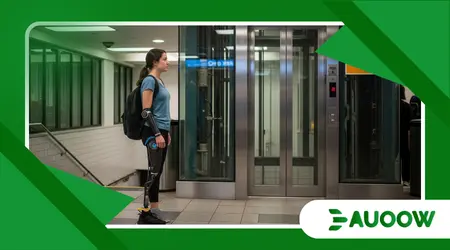
The conversation surrounding Human Augmentation vs Assistive Technology often begins not in a laboratory, but in the quiet, frustrating moments of a Monday morning commute.
Imagine Elena standing at a subway entrance in a bustling metropolis. She wears a sophisticated prosthetic leg, a marvel of carbon fiber and microprocessors.
To the casual observer, she represents the pinnacle of modern engineering.
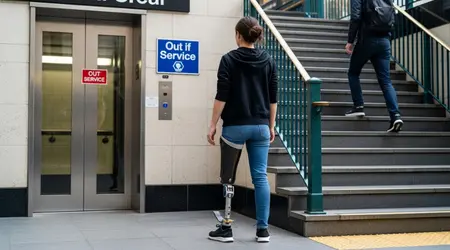
Yet, as she stares at the “Out of Order” sign taped to the only elevator, her high-tech limb becomes secondary to a primitive architectural failure.
In that moment, the distinction between “enhancing” a person and simply “enabling” one to navigate a poorly designed world vanishes under the weight of a concrete staircase.
- The Definitions of Belonging: Distinguishing between tools that restore function and those that aim to transcend it.
- The Economic Divide: How market forces dictate who receives support and who receives “upgrades.”
- Structural Erasure: The risk of focusing on biological fixes while ignoring systemic barriers.
- Legal Frameworks: Why current disability rights laws struggle to categorize emerging tech.
- The Ethical Threshold: Determining when a device stops being a right and starts being a luxury.
Why is the line between “fixing” and “enhancing” so blurry?
We have reached a stage where the hardware used to support the human body is outpacing the language we use to describe it.
Traditionally, assistive technology was defined by its intent: to mitigate a limitation and bring a person closer to a common range of human function.
However, the debate over Human Augmentation vs Assistive Technology complicates this by introducing tools that do not just bridge a gap, but potentially leap over it.
Take, for instance, a cochlear implant that might one day allow a user to stream audio directly to the auditory nerve or translate languages in real-time.
Is that still an assistive device, or has it crossed into augmentation? This blur can be uncomfortable because it challenges our rigid definitions of “normal.”
Society tends to be more accepting of technology that “repairs,” yet becomes wary when that same technology offers what is perceived as a competitive edge.
++ Wearable Assistive Tech in 2026: What Actually Gets Used Daily
What rarely enters the debate about technological “fixes”?
There is a detail often ignored in the rush to celebrate the latest bionic breakthrough: the over-medicalization of disability.
When we frame the challenges faced by people like Elena as biological problems to be solved with better gear, we shift the responsibility away from the city planner and onto the individual.
If everyone is expected to “augment” their way out of an inaccessible world, the incentive to build inclusive infrastructure can disappear.
The focus on high-end hardware can sometimes serve as a distraction from essential, albeit less “flashy,” progress. We marvel at exoskeletons while many schools still lack basic ramps.
The pattern repeats: society often prefers the perceived magic of a technological cure over the sustained political work of social integration.
This creates a hierarchy of accessibility where participation in public life is increasingly tied to the ability to afford an “upgrade.”
How do past policies shape our current view of augmentation?
The legal landscape we navigate today was largely built on the medical models of the 20th century.
Laws like the Americans with Disabilities Act (ADA) were designed to ensure reasonable accommodations.
However, as we weigh Human Augmentation vs Assistive Technology, these frameworks are often ill-equipped for a future of integrated tech.
If a worker uses a neural interface to process data faster than their peers, is that an accommodation or a shift in the baseline of professional expectations?
Historical decisions regarding insurance coverage which often prioritize the “least expensive, most functional” option can trap users in the past.
A basic wheelchair might be covered, while a standing wheelchair, which provides immense health and social benefits, is frequently labeled a luxury.
This fiscal gatekeeping prevents assistive tech from evolving naturally. It risks keeping the body in a state of minimal functionality while the rest of the world moves toward optimization.
Also read: Why Most AI Assistive Tools Still Fail Outside Controlled Environments
Who gets left behind in the race for the “Superhuman”?
The economic chasm in this field is profound. We risk moving toward a reality where disability becomes a marker of economic status rather than biology.
If life-changing interfaces are only available to those with premium insurance or independent wealth, we are effectively coding inequality into our future.
Augmentation is currently a playground for the elite, while basic assistive tools remain a battlefield for the marginalized.
Imagine a student using an AI-integrated contact lens that highlights relevant text. In an affluent setting, this is seen as a cutting-edge study tool.
In an underfunded environment, another student might struggle with a decade-old screen reader that crashes frequently.
The technology exists to level the playing field, yet its distribution often tilts the ground further.
Read more: Why Are Prosthetics Still So Expensive? Breaking Down the Costs
What actually changed after the rise of “Cyborg” Ethics?
The shift from seeing disability as a “deficit” to seeing it as a unique user experience has changed how engineers approach design, yet social structures remain stubborn.
| Feature | The Traditional Assistive Model | The Augmentation-Inclusive Model |
| Design Goal | Restore “normal” human function. | Enhance and customize experience. |
| User Perception | Patient in need of a “fix.” | Early adopter of cutting-edge tech. |
| Stigma Level | Can be high; devices are “hidden.” | Lower; devices seen as wearables. |
| Accessibility Focus | Removing physical barriers. | Integrating digital fluidity. |
| Funding Source | Medical insurance/State grants. | Private investment/Consumer market. |
Why does the “uniqueness tax” hinder true innovation?
A structural detail that consumers and even some advocates often overlook is the cost of specialized manufacturing.
Because assistive tech often serves specific populations, it can lack the benefit of scale. This makes devices prohibitively expensive.
In contrast, augmentation tech like noise-canceling headphones that evolved from hearing aid technology benefits from mass-market appeal.
There is a bitter irony here: the disability community often acts as the primary testers for innovations that eventually become mainstream products.
Once those products become profitable, they are frequently rebranded as lifestyle gadgets, leaving the original users to fight for insurance coverage for the “medical” version.
The profit motive can prioritize the “super” over the human, leaving the fundamental needs of the community behind.
How can we ensure technology remains a right, not a privilege?
We need to reconsider viewing these tools as optional extras.
If a piece of technology be it a screen reader or a neural interface is required for someone to exercise their right to education or employment, it is no longer a gadget.
It is a fundamental civil right. We should move toward Universal Design, where the line in Human Augmentation vs Assistive Technology becomes less relevant because the environment is built to welcome all bodies.
The “line” we draw is often a wall, protecting old ideas about what a body should be able to do.
Instead of policing the boundary between help and enhancement, we should question why society remains poorly designed for so many.
The goal is not to create a few “super-abled” individuals, but a world that does not disable anyone in the first place.
Beyond the Hardware: A Call for Empathy
The true challenge of the coming decade will not just be perfecting the neural link or the carbon-fiber limb.
It will be the ethical work of ensuring that our ingenuity does not outpace our empathy.
As we navigate the complexities of Human Augmentation vs Assistive Technology, we must remember that the goal of innovation is to broaden the human experience, not to narrow the definition of who is “fit” to participate in it.
We should strive for a future where Elena’s prosthetic leg is seen as a beautiful, functional choice, but where the elevator is also working, the doors are wide, and the digital world is open to all.
The “line” we draw should be one of inclusion, regardless of the hardware we use to get there.
FAQ: Understanding the Digital-Biological Frontier
1. Is a pair of smart glasses considered assistive tech or augmentation?
It depends on the context. If used to provide high-contrast visuals for someone with low vision, it is assistive.
If used to display a social media feed during a meeting, it is augmentation. This “dual-use” nature is why legal definitions are currently in flux.
2. Why are “medical” devices so much more expensive than consumer electronics?
The cost is not just in hardware; it is in rigorous testing, liability insurance, and regulatory compliance required for medical interventions.
Consumer tech bypasses many of these hurdles, which is why a smartphone can sometimes be more versatile than a specialized communication device.
3. Will augmentation eventually “cure” disability?
Technology can mitigate limitations, but it does not “cure” the human experience of having a body that functions differently.
Furthermore, many in the disability community do not seek a “cure”; they seek a world that accommodates them as they are.
4. How does “Open Source” tech fit into this debate?
Open-source movements are crucial. They allow communities to 3D-print their own prosthetics and modify software without waiting for a corporation to find it profitable. This shifts power from the manufacturer to the user.
5. Is there a risk that augmentation will create a new form of ableism?
If those who are augmented perform significantly “better” in competitive environments, there is a risk that others will be pressured to upgrade to remain viable.
This could lead to a new social hierarchy based on technological tiers.
6. Can I be forced to use an assistive device by my employer?
Under current labor laws in most democratic nations, you cannot be forced to undergo a medical procedure or use a device against your will.
However, as the workplace becomes more digital, the choice to remain unaugmented may become financially difficult.
