
Bootstrapping vs Venture Capital: What Works Better for Disabled Entrepreneurs?
Bootstrapping vs Venture Capital represents more than just a financial crossroads for a founder with a disability; it is often a choice between maintaining the integrity of an adaptive vision and surrendering to a growth engine that wasn’t built with accessibility in mind.
I remember sitting in a cramped home office in North London, watching a friend named Elias demo a piece of haptic feedback software he’d developed.
Elias is a brilliant engineer and a quadriplegic. His product was seamless, solving a granular navigation issue for wheelchair users that the big tech giants had overlooked for a decade.
But when the conversation turned to “scaling,” the room’s energy shifted. Elias wasn’t sure if he wanted to chase a Series A or keep funding the dream through freelance consulting and steady growth.
He wasn’t just weighing interest rates; he was weighing his autonomy.
For many in this position, the debate is less about “exit strategies” and more about which path allows them to exist in a market that remains stubbornly exclusionary.
Perspectives on the Founder’s Path
To navigate this piece effectively, we will explore:
- The psychological and physical costs of the “Growth at all Costs” model.
- How systemic bias influences the flow of capital.
- The quiet power of self-funding as a tool for inclusive design.
- The structural shifts required to make institutional funding truly accessible.
Why does the traditional funding model often fail disability-led startups?
The venture capital world is built on a specific type of stamina. It’s a culture of “hustle,” late-night pitches, and a physical presence at networking events that are rarely as accessible as the brochures claim.
When we look at why the choice between bootstrapping vs venture capital is so fraught, we have to look at the “founder persona” that VCs have spent forty years cultivating.
This persona is typically someone who can fly across the country on short notice, pull all-nighters, and present a high-energy “vibe” that matches the aggressive expectations of a boardroom.
For a founder managing chronic pain, mobility issues, or neurodivergence, this mold isn’t just difficult to fit it’s often medically and personally unsustainable.
In my years observing this space, what rarely enters the debate is the “disability tax” on time.
When a founder has to spend hours a day on physical therapy or navigating inaccessible transit, they are already working a double shift before they even open their laptop.
VC expectations of hyper-growth don’t account for the biological or environmental reality of the founder’s life.
This creates a friction point where the money offered comes at a price that isn’t listed on the term sheet: the founder’s well-being.
++ Accessible-First Startups: Building Products for Markets Others Ignore
Is self-funding the ultimate tool for creative autonomy?
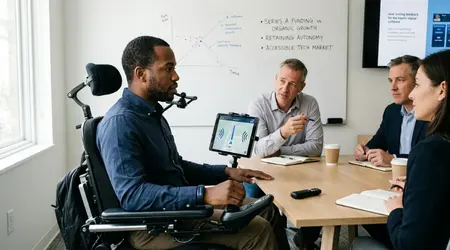
There is a quiet, radical dignity in bootstrapping. When you are the one signing the checks even if those checks are small you hold the power to define what “success” looks like.
For disabled entrepreneurs, this often means the ability to build a company culture that is inclusive by design rather than by HR mandate.
If Elias chooses to bootstrap, he can decide that his company will never have “core hours.”
He can build a remote-first team of other disabled professionals who work when their bodies allow them to be most productive.
This isn’t just about kindness; it’s about optimizing for a different kind of talent.
However, the reality of bootstrapping vs venture capital is that self-funding requires a baseline of personal wealth or a high-margin service that can fund product development.
Because of the historical socio-economic barriers faced by people with disabilities higher unemployment rates and the “extra costs” of living many founders simply don’t have the “friends and family” round that their non-disabled peers take for granted.
We often talk about bootstrapping as a choice, but for many in the community, it is a forced necessity because the gates to institutional capital remain locked.
The invisible barriers in the pitch room
When we observe the data, a pattern repeats: investment goes to what is familiar. Most venture capitalists are looking for a “solution” to a problem they personally understand.
This creates a massive blind spot. A founder pitching a revolutionary way to handle digital Braille might be met with blank stares by a room of investors who have never considered how a blind person uses an iPhone.
There is a structural detail that analysts often ignore: the “pity trap.”
Too often, when a disabled founder enters a pitch room, the conversation shifts from the technical viability of the product to the “inspiring” story of the founder.
While this might feel like empathy, it is actually a form of infantilization that devalues the business.
VCs invest in returns. If they see a founder primarily through a lens of charity or social impact rather than market disruption, they are less likely to write the check.
This makes the bootstrapping vs venture capital divide even wider, as founders realize they might have to “perform” their disability to get attention, but hide its realities to get the cash.
Also read: Digital Freelancing: A Game-Changer for Disabled Professionals?
How do past policies shape today’s entrepreneurial landscape?
Inclusion isn’t a “new” trend, though the tech world likes to treat it as such. The barriers Elias faces today are direct descendants of 20th-century urban planning and labor laws.
When we see how decisions made decades ago like the lack of mandatory elevator access in commercial buildings or rigid “40-hour office week” standards still impact where networking happens, we see why venture capital remains so homogenous.
If the premier startup mixers are held in basement bars or spaces with no accessible restrooms, an entire class of entrepreneurs is silenced.
This is where the structural connection becomes clear. Decisions made by architects in the 1970s are currently influencing which companies get funded in 2026.
The shift toward bootstrapping vs venture capital is often a response to this physical exclusion. If I can’t get into the room where the deals are made, I will build my own room from my living room.
A Comparative Look at Growth Strategies
| Feature | Bootstrapping | Venture Capital |
| Control | Absolute. You define the accessibility standards. | Shared. Investors may push for “efficiency” over inclusion. |
| Pace | Organic. Fits the founder’s physical/mental capacity. | Hyper-growth. Can lead to burnout for disabled founders. |
| Market Focus | Niche. Solving deep, specific accessibility problems. | Mass Market. Pressures to “pivot” to broader, less inclusive apps. |
| Risk | Personal financial risk is high, but equity stays. | High pressure to “exit” (sell the company or go public). |
Imagine the “unconventional” founder in a high-stakes meeting
Think of a worker who has spent fifteen years navigating the world with a visual impairment.
They have developed a unique cognitive map of how information flows one that a sighted person could never conceptualize.
They decide to build a fintech app that uses auditory data cues instead of visual charts.
In a bootstrapping scenario, they spend three years perfecting the UX with a small group of loyal users. The growth is slow, but the product is perfect.
In a venture capital scenario, they are told they need to add “visual flair” to attract a wider demographic within six months. The core innovation the auditory data gets pushed to a secondary feature.
The founder is stressed, their health suffers, and the very thing that made the startup special is diluted to satisfy a quarterly growth target.
This isn’t a hypothetical; it’s the standard trajectory for many who choose the VC route without finding “impact-first” investors.
Read more: Robotics and Automation: Threat or Opportunity for Disabled Workers?
What actually changed after the 2024-2025 DEI backlash?
In the last couple of years, we’ve seen a cooling of “Diversity, Equity, and Inclusion” (DEI) initiatives. Disability was often the last to be included and the first to be cut.
Consequently, the choice of bootstrapping vs venture capital has become even more polarized.
Founders are increasingly looking toward “Zebra” companies businesses that are profitable, improve society, and emphasize long-term sustainability rather than the “Unicorns” that VCs hunt.
This shift is a survival mechanism. When institutional support wavers, the community leans back into self-reliance and peer-to-peer funding networks.
We are entering an era of “Community-Led Growth,” where disabled founders fund each other, bypassing the traditional gatekeepers entirely.
Is there a middle ground for the modern entrepreneur?
There is a third path emerging, often called “Revenue-Based Financing.”
It allows founders to get capital without giving up massive equity or committing to the “all-nighter” culture of Silicon Valley. You pay back the investment as a percentage of your revenue.
For the disabled entrepreneur, this might be the bridge that makes the bootstrapping vs venture capital debate obsolete. It provides the fuel to scale without the predatory timelines that ignore human frailty.
It recognizes that a business can be highly successful without being a billion-dollar “moonshot.”
The future of accessibility isn’t just in the products we build, but in the financial models we use to build them.
FAQ Editorial: Navigating the Business of Inclusion
Is it harder for disabled founders to get VC funding?
Statistically, yes. Investors often perceive disability as a risk to “founder endurance.” However, many founders are now finding success by targeting “Impact Funds” that specifically look for social ROI alongside financial gains.
Can I switch from bootstrapping to VC later on?
Absolutely. In fact, showing that you have built a profitable, lean business on your own often gives you more leverage in VC negotiations, as it proves market demand and your personal resilience.
What is the “disability tax” in entrepreneurship?
It refers to the extra time, energy, and money disabled founders must spend on things their peers don’t like accessible software, specialized transport, or healthcare which can make the early days of a startup more challenging.
How do I know which path is right for my health?
It comes down to your “operating system.” If your health requires a highly predictable schedule and lower stress, bootstrapping offers more control. If your product requires massive upfront R&D costs and you have a strong support system, VC might be worth the trade-offs.
