
Why Disability Rights Require More Than Legal Protection
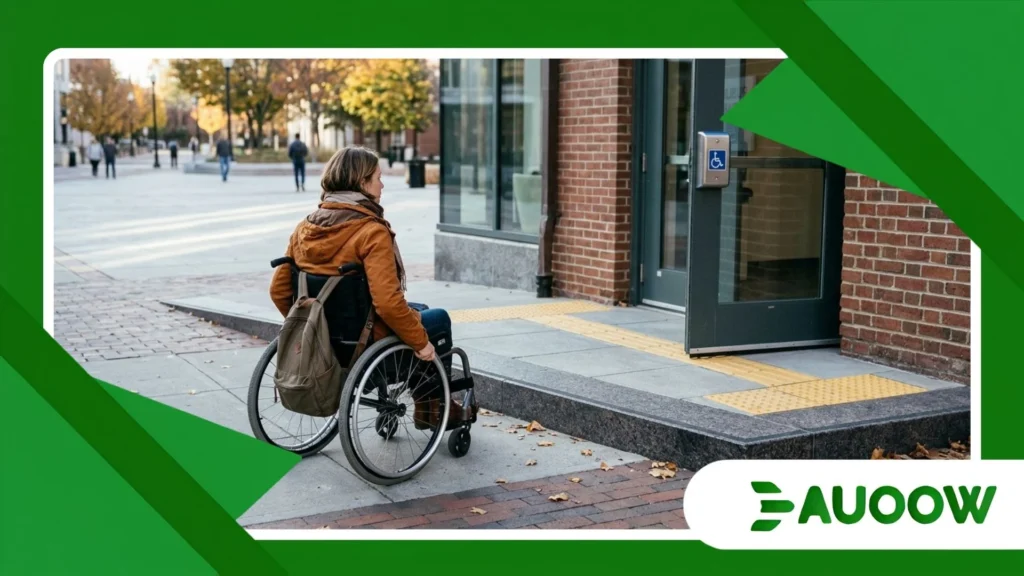
On a crisp October morning in a refurbished city center, a commuter using a wheelchair approaches a newly renovated public library, only to find her path blocked by a single stone step.
The building satisfies every item on the municipal compliance checklist: tactile paving marks the intersection, signs are clearly visible near the entrance, and an automated opener is fitted to a heavy glass door.
Yet that four-inch lip of polished granite an aesthetic choice added late in architectural revisions leaves the automated door entirely out of reach.
It is a quiet, everyday friction point. The law declared the facility accessible, inspectors signed off on the certificates, but real-world experience reveals a different reality.
Disability rights require more than legal protection if we are ever to build a truly inclusive society.
Key Perspectives in This Analysis
- The Compliance Trap: How meeting statutory minimums creates a false sense of institutional success.
- Historical Continuity: The line connecting early civil rights statutes to modern digital and physical barriers.
- Economic Realities: Why corporate and public budgets routinely treat accessibility as a secondary expense.
- Practical Frameworks: A comparative look at legal standards versus genuine lived accessibility.
- Cultural Transformation: Shifting social attitudes from passive tolerance to proactive design.
Why Do Modern Cities Still Fail Those Who Live in Them?
Urban development over the last three decades highlights a paradoxical pattern.
Statutory protections for disabled people have expanded across many nations, bringing comprehensive anti-discrimination acts, detailed building codes, and international conventions ratified by global bodies.
Yet navigating a city often remains full of unexpected barriers.
This gap exists largely because institutions misinterpret their obligations. For many project managers and urban planners, accessibility is treated as a final checklist item rather than a foundational design principle.
What rarely enters this discussion is the difference between legal non-discrimination and functional inclusion.
A law can prohibit a transit authority from turning away a passenger who uses a wheelchair, and it can mandate working elevators at major transit hubs.
However, legislation rarely dictates how quickly a broken lift must be repaired, or whether a transit system’s mobile application can be navigated easily by a blind commuter checking real-time service updates.
Law sets the legal frame, but daily engineering and operational choices determine whether someone actually reaches work on time.
++How Public Policy Can Reduce Everyday Accessibility Barriers
What Has History Taught Us About the Limits of Legislation?
The belief that passing a law resolves a social issue is a long-standing assumption in policy design.
Decades ago, when pioneer activists blockaded buses and marched on public capitals, their objective was clear: establish landmark statutory guarantees recognizing disabled citizens as full members of public life.
Those legal victories were essential, altering the legal standing of millions of people and creating pathways to challenge outright exclusion.
Looking closely at history, we see this pattern repeat across eras. Legislation creates a baseline, yet baseline standards frequently become maximum ceilings rather than starting floors.
Consider early public education reforms. Statutes mandated that children with physical or cognitive differences be granted access to public school buildings.
Decades later, while physical doors are open, school districts often struggle to provide adapted learning tools, specialized assistance, or sensory-friendly spaces.
The legal obligation was met when the student entered the classroom, yet the practical right to a meaningful education often remains incomplete.
Also read: The impact of assistive technology rights on public healthcare
How Does the Digital Divide Mirror Physical Barriers?
The migration of essential public services to online environments has highlighted these systemic limitations.
Today, routine activities from renewing a driver’s license to filing taxes or scheduling a doctor’s appointment take place behind digital screens.
| Sector | Legal Minimum Standard | Real-World Limitation | Path to Real Accessibility |
| Public Transit | Accessible vehicles on primary routes | Broken elevators and unannounced stops | System-wide redundant infrastructure and live updates |
| Built Environment | Retrofitted side entrances and ramps | Long detours and isolated entry points | Integrated universal architecture from design inception |
| Higher Education | Captioned recorded lectures upon request | Slow processing times and poor audio quality | Native captioning and multi-modal materials for all courses |
| Employment | Reasonable accommodation procedures | Administrative friction and career stagnation | Default flexible working models and inclusive leadership |
In the early days of the web, advocates anticipated that digital environments would democratize access by removing spatial limitations like steps and heavy doors.
Instead, many platforms were built without accounting for screen readers, keyboard navigation, or visual contrast needs.
As accessibility challenges mounted, organizations frequently turned to automated overlay widgets quick visual fixes that satisfy superficial checks without addressing faulty underlying source code.
Here again, daily experience demonstrates why disability rights require more than legal protection in a digital world.
A website may claim compliance through third-party tools, while a screen reader user remains unable to complete a basic form or read an emergency notice.
What Happens When Accommodations Meet Corporate Realities?
To understand why everyday inclusion lags behind policy, we can examine how workplace accommodations play out in corporate environments.
Consider a deaf financial analyst who joins a consulting firm that highlights its commitments to diversity.
Her employment fulfills internal hiring goals, and on paper, the organization offers required statutory guarantees.
However, daily operations reveal significant friction. Weekly team debriefs frequently rely on uncaptioned video calls, while informal strategy sessions take place in noisy settings where lip-reading is difficult.
When she requests real-time transcription services for client presentations, the process moves through multiple layers of procurement, delayed by managers evaluating whether the cost fits within operational budgets.
A key structural issue in these scenarios is that legal frameworks often position accommodations as individual requests rather than standard operating procedure.
By categorizing adaptive software, sign language interpreters, or flexible schedules as special accommodations, systems can unintentionally treat disabled employees as administrative burdens.
Sustainable inclusion requires a broader shift in workplace culture.
It means building environments where flexible schedules, captioned media, and accessible documentation are default practices for everyone, reducing the need for individuals to repeatedly request permission for basic participation.
Read more: The Future of Accessible Public Transportation Policies
Why Is Cultural Attitude the Ultimate Catalyst for Change?
Laws govern behavior through rules and penalties, but they cannot enforce empathy, awareness, or thoughtful design.
A city can enforce strict parking regulations, but those rules do not prevent delivery vehicles from blocking sidewalk ramps if community awareness remains low.
Meaningful progress occurs when society moves away from viewing accessibility as a technical requirement and begins treating it as a fundamental aspect of universal design.
When a sidewalk curb cut is built, it serves parents pushing strollers, travelers rolling luggage, and delivery workers moving goods.
Similarly, when video content includes clear captions, it assists viewers learning a new language or watching content in quiet settings. Universal design strengthens public infrastructure for the entire community.
Relying primarily on legal action and enforcement can foster an adversarial dynamic, framing inclusion as a matter of litigation rather than a shared civic responsibility.
While legal frameworks remain essential for holding institutions accountable, they are most effective when paired with education, proactive investment, and the active involvement of disabled individuals in civic planning.
Reimagining the Future of Human Belonging
An accessible world cannot be achieved by mandates alone. It requires a conscious effort to rethink how we value human diversity, design our environments, and organize our daily routines.
Legal protections establish an essential baseline, defining the basic standard of fairness a society agrees to uphold. But a baseline is only a starting point, not a complete solution.
True inclusion requires environments that welcome everyone naturally, tools that adapt seamlessly to diverse human needs, and institutions that respect individual presence without requiring constant legal intervention.
Our current approach often reaches a plateau where an extensive framework of rights, standards, and oversight bodies exists, yet millions of individuals encounter unnecessary daily barriers.
Moving past this plateau involves shifting our focus from simple regulatory compliance toward human-centered design principles.
Ultimately, achieving meaningful inclusion means recognizing that disability rights require more than legal protection they demand civic commitment, cultural empathy, and a shared dedication to building communities where every person can participate fully and independently.
Frequently Asked Questions
Why aren’t existing disability protection laws enough to guarantee full accessibility?
Laws establish minimum standards and legal remedies for discrimination, but they rarely dictate day-to-day maintenance, design quality, or social attitudes.
Enforcement often depends on individuals filing complaints after a barrier is encountered, rather than preventing barriers before they are built.
What is the difference between legal compliance and universal design?
Legal compliance focuses on meeting specific statutory requirements, often adding retrofits like ramps or elevators after a space is built.
Universal design plans environments, products, and services from the start so they can be used by everyone, regardless of age, size, or ability, without needing adaptation.
How can businesses move beyond basic legal requirements for accessibility?
Companies can involve disabled users in product testing, adopt universal design across digital and physical infrastructure, budget proactively for accommodations, and build a workplace culture where flexibility and clear communication are standard practices for all employees.
What role do everyday citizens play in supporting disability rights?
Everyday citizens contribute by keeping accessible paths clear, advocating for accessible public spaces in local planning meetings, creating accessible digital content (such as adding alt text and captions), and challenging ableist assumptions in their communities.
