
Why Smart Cities Are Not Always Accessible Cities
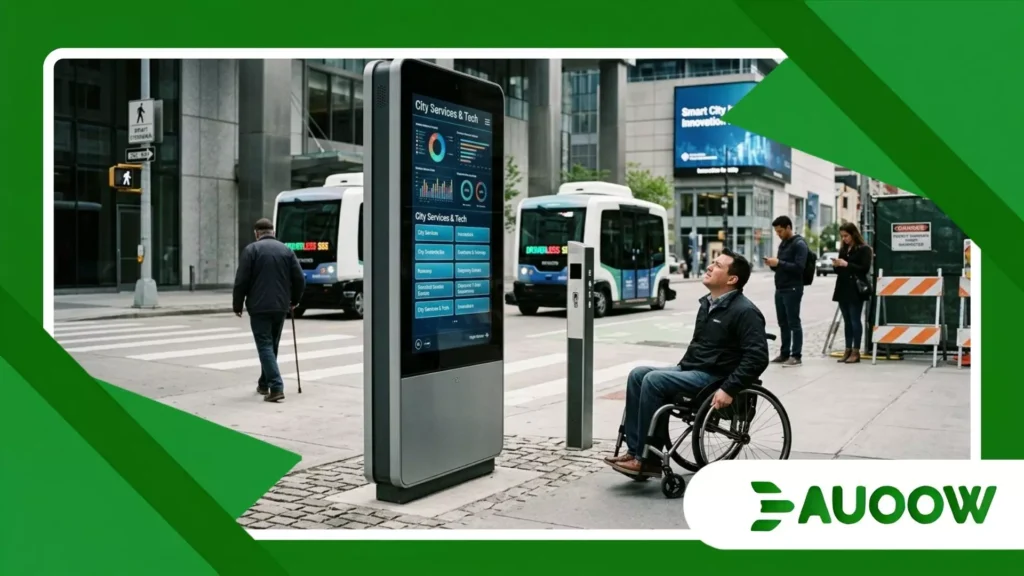
A sleek touchscreen kiosk glows on the newly renovated corner of 4th Avenue, demonstrating that smart cities are not always accessible cities for the people who navigate them every day.
Elena stands two feet away in her motorized wheelchair, her hand hovering in front of the glare.
The digital transit interface sits at five feet six inches far beyond her reaching radius. There is no audio prompt, no tactile feedback, and no physical button to press.
A quarter-mile down the street, an autonomous delivery pod crawls smoothly along a polished concrete sidewalk, its sensors humming quietly.
To an urban planner flipping through a promotional deck, this neighborhood looks like the future.
To Elena, it looks like an obstacle course designed with invisible digital walls. The curb cut is blocked by a dockless electric scooter, parked precisely where the machine’s geo-fencing allowed it to lock.
This tension between technological elevation and basic spatial usability defines urban life across much of the world today.
What to Expect in This Article
- The Silicon Mirage: How high-tech urban designs confuse digital connectivity with physical freedom.
- Historical Echoes: Why digital infrastructure inherits the exclusive architectural choices of the past.
- The Sensor Gap: How data collection models systematically overlook disabled citizens.
- A Real-World Reality Check: What happens when automated transit fails in daily commuter scenarios.
- Redesigning the Blueprint: Actionable frameworks for truly inclusive civic design.
Why Do High-Tech Urban Plans Leave So Many People Behind?
When municipal authorities talk about smart technology, they usually mean efficiency, data collection, and resource optimization.
They talk about algorithms that adjust traffic lights, sensors that monitor air quality, and apps that streamline parking payments.
What rarely enters this debate is how these systems interact with human variation. An algorithm designed to optimize foot-traffic flow often treats a person using a white cane or a walker as an anomaly a slow-moving data point rather than a resident with rights.
- Traditional Urban Barrier: Physical steps and curbs, heavy manual doors, narrow pedestrian paths.
- Smart City Urban Barrier: Inaccessible touchscreen kiosks, app-only bus ticketing, geo-fenced scooter drift.
The fundamental flaw lies in the original architecture of the smart city concept itself. Cities are being built around data streams rather than human bodies.
When a city council invests millions in digital infrastructure, accessibility is often treated as a software patch to be applied later.
Yet, you cannot patch a curb cut that was never poured, nor can you retrofit a touchscreen kiosk that lacks a headphone jack once it is already bolted into concrete.
There is a structural detail that demands closer attention: convenience for the average user is routinely mistaken for accessibility for all users.
A smartphone app that lets someone rent a bike in three seconds is convenient. However, if that same app is the only way to purchase a bus ticket, it instantly erects a barrier for residents with tremors, visual impairments, or lower digital literacy.
Technology in public spaces frequently amplifies existing social divides instead of dissolving them.
When we prioritize high-tech convenience over universal access, we end up reinforcing the reality that smart cities are not always accessible cities for disabled residents who rely on those spaces every day.
++ Smart Home Features That Actually Improve Independence
Are We Repeating the Architectural Mistakes of the 20th Century?
To understand where high-tech urban planning falls short, we have to look back at the post-war suburban boom.
Mid-century architects designed cities almost exclusively around the private automobile. They built sprawling highways, high curbs, and vast parking lots, operating on the assumption that every citizen was an able-bodied driver.
It took decades of persistent disability rights advocacy to compel cities to rethink their physical foundations.
Today, a strikingly similar pattern is unfolding, except the automobile has been replaced by the digital platform.
Urban planners are once again designing around an idealized user archetype: a young, tech-savvy professional who navigates the world with a smartphone in hand.
- 1950s Urban Planning: Centered on the automobile, assumed able-bodied drivers, built physical barriers.
- 2020s Smart City Planning: Centered on the smartphone, assumes tech-literate pedestrians, embeds digital barriers.
Read more: The rise of smart crosswalk accessibility in urban mobility plans
The pattern repeats. Just as early 20th-century transit systems lacked ramps, 21st-century digital hubs often lack basic screen-reader compatibility or high-contrast interfaces.
The underlying mindsets remain unchanged when decisions occur in boardrooms where disabled individuals are absent from the design process.
Legislative frameworks struggle to keep pace. While building codes govern physical ramp slopes and doorway widths, guidelines regarding digital interfaces in public spaces remain far less explicit.
If a public water fountain is physically unreachable, it clearly violates accessibility mandates.
But if a public transit ticketing system exists entirely within an inaccessible app, city administrators often treat it as a minor technical glitch rather than a barrier to public infrastructure.
What Happens When Automated Systems Encounter Real Life?
Consider a metropolitan area that introduced an automated, driverless shuttle fleet in its downtown core. On paper, the project offered clear advantages: reduced carbon emissions and lower municipal operating costs.
In practice, a wheelchair user named Marcus encountered a very different reality on his morning commute.
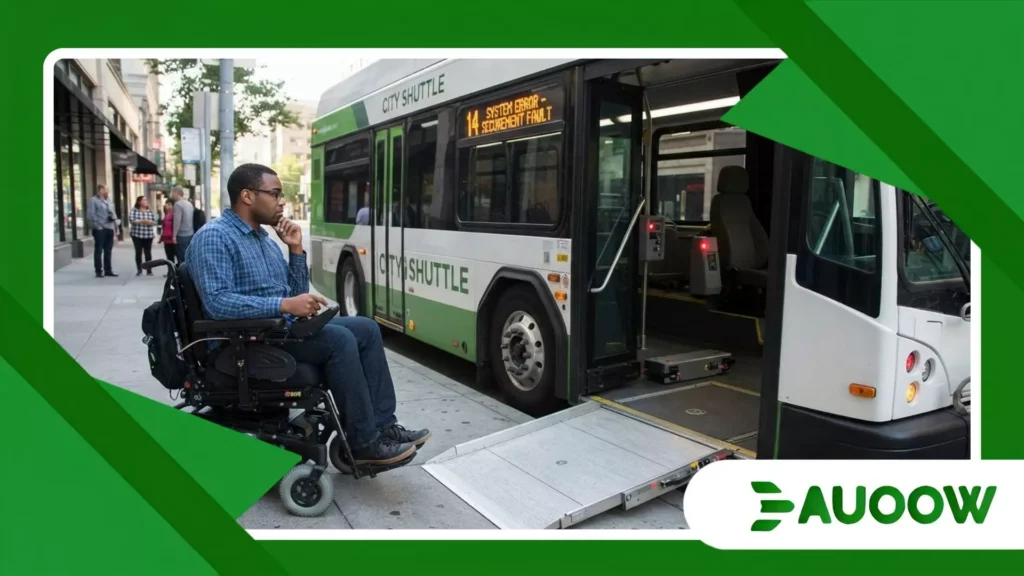
When Marcus approached the shuttle, the automated ramp deployed as intended. However, the internal docking mechanism failed to recognize his non-standard power chair model.
Without human staff on board to assist with manual tie-downs or troubleshoot the system, the shuttle sat idling at the curb before issuing an automated error code and moving on to the next stop.
- Initial Assumption: Automated shuttles would make public transit cheaper and more efficient for everyone.
- Actual Outcome: Removing human staff created insurmountable barriers for passengers needing physical aid.
- Systemic Solution: Cities began requiring universal hardware standards and remote human backup operators.
Marcus was left on the sidewalk in the rain. This episode illustrates why smart cities are not always accessible cities when flexibility is stripped from public infrastructure.
Sensors and automated systems excel at handling predictable environments, but human life is inherently varied.
When public services eliminate human support staff solely in the pursuit of operational efficiency, they often remove the safety net that allows disabled citizens to navigate public spaces independently.
Who Truly Benefits from the Smart City Data Stream?
Data collection is the lifeblood of the modern connected city. Sensors monitor traffic flow, track pedestrian volume, and measure energy usage across municipal grids. Yet, the underlying data models can be inherently selective.
If a smartphone app tracks foot traffic to determine where new crosswalks or benches should be installed, it only registers people who own smartphones and actively use those specific apps.
A blind individual navigating with a guide dog, or an elderly resident who does not carry a location-tracking device, remains effectively invisible to the system.
| Civic Technology | Primary Intended Purpose | Unintended Accessibility Barrier |
| Dockless E-Scooters | Micro-mobility & emission reduction | Parked scooters block sidewalks and tactile paving |
| Touchscreen Kiosks | Wayfinding & local information | Inaccessible height, screen glare, lack of physical buttons |
| App-Only Ticketing | Contactless transit entry | Excludes non-smartphone users or people with low vision |
| Automated Transit Hubs | Cost-effective public transport | Lacks human assistance for non-standard boarding needs |
When city services are allocated based on incomplete data, systemic inequities widen.
Benches might be removed from areas where data suggests “low dwell times,” overlooking the reality that residents with mobility conditions depend on those benches to rest during longer walks.
Crosswalk timers calibrated to the average walking speed of an adult without mobility impairments leave those with slower gaits stranded mid-crossing.
Until accessibility experts and disabled community members have direct input into how civic data is defined and gathered, smart infrastructure will continue to serve a limited segment of the population.
Also read: Why facial recognition accessibility raises daily access concerns
Key Takeaways for Civic Leaders
- Inclusion from Day One: Digital and physical accessibility must be built into civic hardware and software procurement contracts, rather than added as a retrofit later.
- Diversify Civic Data: Avoid relying solely on smartphone app metrics to understand how residents move through and use public spaces.
- Combine Human Support with Automation: Automation should assist public transit workers, not eliminate the human oversight needed for flexible, accessible service.
How Can We Rebuild the Vision of Inclusive Smart Cities?
To build a city that is genuinely intelligent, municipal leaders must broaden how they define innovation.
Urban intelligence is not measured by the density of sensors in the pavement, but by how freely every resident can navigate public space.
First, cities must adopt universal design standards across physical and digital systems.
A touchscreen public kiosk should be paired with a tactile keypad and a standardized headphone port for audio navigation.
Digital apps for municipal services need to meet established web content accessibility standards before receiving public funding.
Second, civic procurement policies must mandate co-design with disabled residents.
Before a city purchases a fleet of automated transit vehicles or permits micro-mobility options, disabled community members must test those systems in real-world conditions.
Feedback from wheelchair users or pedestrians with low vision should carry genuine weight in public deployment decisions.
Finally, physical human presence remains an essential component of accessible design. Technology should augment human support, not eliminate it entirely.
An automated transit hub functions far more effectively when trained staff are available to handle edge cases and offer assistance when hardware fails.
Universal design is not an extra expense or a final compliance check; it is a foundational public responsibility.
When we design spaces that accommodate diverse physical and cognitive needs, we build environments that are safer, clearer, and easier to navigate for everyone from parents with strollers and delivery workers with hand trucks to elderly citizens and injured pedestrians.
Only when we align technical innovation with genuine human inclusion will we stop needing to explain why smart cities are not always accessible cities to the people standing on their sidewalks.
Frequently Asked Questions
Why do smart city initiatives frequently overlook accessibility?
Most smart city projects are led by technology providers and urban planners prioritizing efficiency, automation, and data gathering.
Disabled communities are rarely included in the initial design and testing stages, leading to solutions that function well for non-disabled residents while creating new barriers for others.
How can a digital transit app create physical barriers for pedestrians?
When cities shift essential public services exclusively to digital platforms, residents without smartphones, those with visual or motor impairments, or those with lower digital literacy are excluded.
If an app is the sole method to buy a ticket, access a restroom, or locate a bus stop, digital design directly restricts physical movement.
What is universal design in the context of urban planning?
Universal design is the practice of creating products, environments, and services that are usable by all people, to the greatest extent possible, without requiring specialized adaptation.
In a smart city context, this means integrating tactile, audio, and physical alternatives alongside digital screens and mobile apps.
Are dockless e-scooters considered a barrier to urban accessibility?
Yes. While dockless electric scooters offer convenient micro-mobility for many residents, they are frequently parked across sidewalks, curb cuts, and tactile paving.
For blind pedestrians or wheelchair users, these improperly parked vehicles become substantial physical hazards.
How can cities ensure automated transit remains accessible to everyone?
Cities can ensure accessibility by requiring non-standard boarding capabilities, maintaining human support staff at key hubs, establishing universal wheelchair docking standards, and involving disability advocates in safety and usability trials prior to public deployment.
