
The rise of smart crosswalk accessibility in urban mobility plans
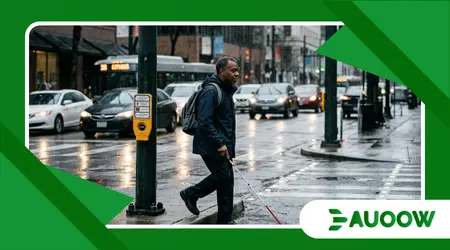
The rise of smart crosswalk accessibility is rarely heralded by a parade; it usually begins with the quiet, rhythmic chirping of a localized signal on a rainy Tuesday morning in a city that finally decided to listen.
Elias, a regular commuter who has navigated the intersection of 5th and Main with his white cane for over a decade, doesn’t see the flashing LED beacons or the sensor-embedded pavement as “revolutionary technology.”
For him, the change is visceral: the sudden, reliable realization that the signal timing has adjusted to his pace, rather than forcing him into a frantic, heart-pounding race against a countdown clock designed for the average, able-bodied runner.
That brief window of safety is not a miracle of engineering.
It is the result of a long, often frustrating friction between aging municipal infrastructure and a growing insistence that public space belongs to everyone, not just those who can sprint across a road before the light turns red.
A brief look at the shifts ahead
- The evolution from passive signals to responsive, intelligent urban nodes.
- Why the “average pedestrian” metric is a historical design failure.
- Navigating the balance between surveillance and safety in digital infrastructure.
- The socio-economic impact of designing for the slowest user first.
Beyond the “Average Pedestrian” Fallacy
We often speak of city planning as if it were an objective science, governed by cold mathematics and traffic flow simulations.
But look closer at any city grid, and you will see the ghosts of 1950s planning decisions choices that prioritized the velocity of automobiles above the dignity of the human foot.
In those days, traffic engineers calculated “clearance intervals” based on the assumption that every person walking was able-bodied and moving at a brisk, consistent pace.
The rise of smart crosswalk accessibility challenges this foundation. It forces planners to acknowledge that the “average” human is a statistical convenience.
When we design for the center of the bell curve, we systematically alienate the edges the elderly, children, people with temporary injuries, and the millions living with permanent mobility or sensory disabilities.
What rarely enters the mainstream discourse is how these old metrics essentially codified ableism into our asphalt.
If a light cycle is too short for an older adult to cross, is that a failure of the adult, or a failure of the architecture?
By shifting to “smart” systems those equipped with computer vision or pressure-sensitive mats we are finally updating the software of our cities to match the reality of their inhabitants.
Also read: Toothbrush Tech for Disabled Users: The Rise of Y-Brush and Alternatives
When Technology Becomes an Extension of Will
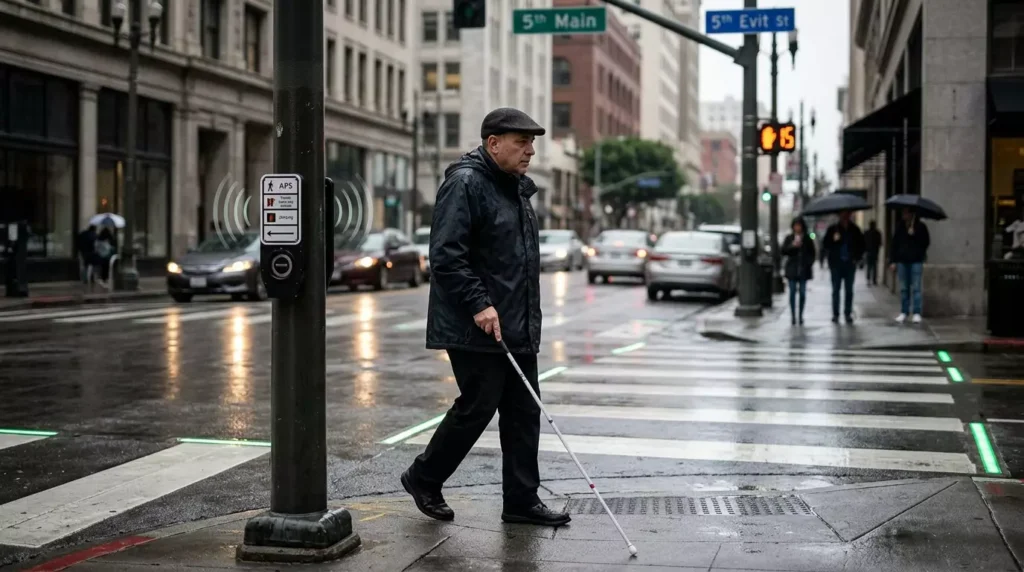
The transition from static to responsive signals is not just about upgrading hardware; it is about rewriting the social contract of the sidewalk. There is a structural detail that often gets ignored in project brochures: the issue of agency.
In the past, the button on a pole was a request, not a guarantee. You pressed it, and you waited, hoping the central computer acknowledged your presence.
Today, the integration of sensors that detect intent or utilize mobile connectivity to notify the signal of a user’s specific needs changes the power dynamic.
It moves the user from a supplicant begging for the right of way to a participant in a communicative system.
The rise of smart crosswalk accessibility brings with it a quiet, transformative potential. Imagine a world where the infrastructure recognizes you, not as a mass of pixels, but as a person with a specific need for time or auditory feedback.
This is about ensuring that the environment becomes an extension of our collective will to be inclusive, rather than an indifferent gauntlet of steel and light.
++ The problem with touchscreen kiosks accessibility in public spaces
The Hidden Cost of “Efficiency”
There is a legitimate debate regarding the cost and the potential for digital exclusion. Critics often ask if we are merely replacing physical barriers with digital ones.
If a system relies on a smartphone app, what happens to the person who cannot afford the latest handset? Or those who, due to the digital divide, remain disconnected from the municipal grid?
A truly equitable system cannot be tiered by technological literacy. The most successful implementations act as a “blanket” rather than a “lock.”
They provide ambient intelligence that benefits everyone without requiring a subscription, a login, or a specific demographic profile.
When we observe these systems closely, the pattern repeats: the best technology is that which is invisible.
This innovation is at its best when it functions like a sidewalk curb cut a design choice so sensible and so integrated that we eventually wonder how we ever managed to navigate the city without it.
| Technology Type | Primary Benefit | Potential Barrier |
| Computer Vision Sensors | Automatic extension of walk time | Privacy concerns |
| Mobile-integrated Signal Apps | Personalized alerts | Digital divide |
| Haptic/Audio Beacons | Instant sensory feedback | Localized noise concerns |
Why We Are Playing Catch-up
Historically, inclusivity in urban planning has been treated as an “add-on” a retrofit performed only after a lawsuit or a public outcry.
We see this in the remnants of 1990s legislation, which focused heavily on mandated ramp slopes and doorway widths. These were essential, but they were often reactive.
We can move beyond mere compliance. The current generation of smart infrastructure allows us to be proactive.
We are no longer asking if a sidewalk is wide enough; we are asking if the intersection itself is “aware” of the people using it.
This marks a shift from viewing disability as a problem to be mitigated by physical space to viewing it as a core design parameter for civil engineering.
There is an irony here. For decades, we tried to fix the individual to fit the environment. Now, we are finally fixing the environment to fit the individual.
The rise of smart crosswalk accessibility is a signal that this tide is turning, even if the progress feels slow to those currently waiting on the wrong side of a busy intersection.
The Human Element
Consider a case study from a mid-sized European city. They implemented a simple detection system at a high-traffic crossing near a school for the blind.
The technology wasn’t flashy; it didn’t utilize massive data sets. It simply used localized sensors to trigger an extended phase and a specific auditory tone when someone was waiting at the curb.
The impact was a significant reduction in “near-miss” incidents and a measurable increase in the independence of students who no longer felt the need to rely on sighted companions to traverse that block.
That is the true metric of success. It wasn’t the sophisticated sensor that changed the city; it was the policy decision to prioritize the safety of those most vulnerable.
Read more: Cleaning Made Easy: Accessible Vacuum and Robot Solutions
Designing Cities for Human Dignity
As we look toward the next decade of development, the rise of smart crosswalk accessibility serves as a litmus test for our values.
It forces us to ask what kind of society we want to build. Do we want cities that demand we fit into their rigid, high-speed boxes?
Or do we want cities that are as fluid, diverse, and adaptable as the people who live within them?
The infrastructure of the future should not just move traffic it should move people, all of them, with the respect and urgency they deserve.
Editorial FAQ: Understanding the Shift
Are smart crosswalks actually safer?
Data suggests that when signals are responsive to pedestrian needs, risk decreases. They are solutions to the incompatibility between fast-moving cars and slower-moving pedestrians.
What happens if the power goes out?
Any robust urban design includes “fail-safe” mechanical modes. These systems should complement, not replace, standard visual signals.
Is this technology leading to more surveillance?
This is a critical concern. The best implementations use edge-processing, where data is discarded locally rather than stored. We must demand transparency from municipal developers.
Why aren’t all cities adopting this immediately?
Budgetary constraints and the inertia of legacy infrastructure are the primary hurdles.
How can I advocate for these changes?
Start by documenting points of failure. If you have a specific intersection that is inaccessible, report it through the proper channels and join local urban planning committees.
Your anecdotal evidence is the start of institutional data.
