
How accessible public Wi-Fi systems affect digital inclusion today
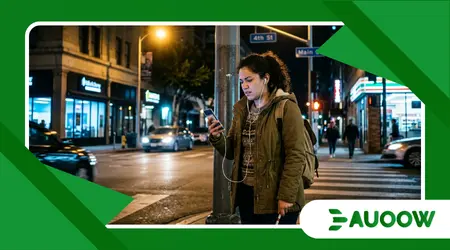
Maria stands on the corner of 4th and Main, her phone screen illuminated by the harsh glare of a streetlamp.
She is not waiting for a ride or checking a social media feed; she is hunting for a sliver of connectivity.
For Maria, who relies on a screen reader to navigate her digital world, a stable connection is not a luxury it is the bridge between her autonomy and isolation.
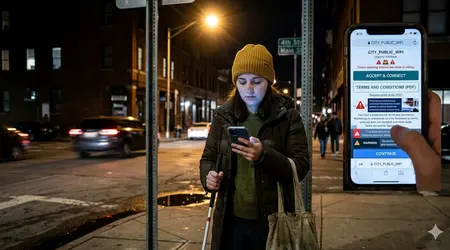
Yet, the signal she finds is inconsistent, plagued by captive portals that are visually cluttered, inaccessible to her assistive software, and prone to dropping the moment she moves a few feet.
It is in these quiet, frustrating moments that we must confront how accessible public Wi-Fi systems affect digital inclusion today, revealing a systemic oversight that turns public spaces into exclusionary zones.
We often talk about the “digital divide” as if it were a flat, binary line those with internet and those without.
But the reality is more textured, stratified by the quality and usability of the infrastructure we take for granted.
We have built a world that assumes everyone can navigate a login page, read standard text, or tolerate a five-second latency.
For millions, that assumption is a wall. This exploration dives into the mechanics of our connectivity, the policies that leave gaps in our urban fabric, and why the “public” in public Wi-Fi remains a contested space.
The hidden architecture of digital exclusion.
Why accessibility is often treated as an afterthought in municipal planning.
The intersection of policy and user-centric design.
Real-world shifts in how we define “essential” infrastructure.
The Architecture of the Login Page
When we design public infrastructure, we obsess over physical ramps and tactile paving. We understand that a curb is an insurmountable obstacle for someone who uses a wheelchair.
Yet, when we transition to the digital realm, that same physical sensibility often evaporates.
Captive portals those landing pages that demand authentication before allowing you to browse are the digital equivalent of a revolving door that only accepts one specific key.
What rarely enters the public discourse is that these portals are seldom audited for screen-reader compatibility.
They are built for speed and ad-revenue optimization, not for the person who needs extra time to process information or who utilizes assistive technology to interface with the web.
If the button to “Accept Terms and Connect” is not tagged correctly in the code, the entire network might as well not exist.
There is a structural detail that is frequently ignored: the reliance on visual cues for connectivity status.
A green light on a router is meaningless to a user who cannot see it, yet our urban design often forgets to integrate non-visual indicators for network status.
When accessible public Wi-Fi systems affect digital inclusion today, they do so by either opening doors or locking them shut based on the sophistication of the user’s hardware and their ability to navigate poorly designed interfaces.
Historical Shadows and Current Realities
To understand why this remains a problem, we must look at how we categorized the internet decades ago. In the early 2000s, the web was viewed as a supplemental tool.
Policies drafted during that era, which still influence municipal budgets, did not treat connectivity as a civil right.
Consequently, when cities began installing mesh networks or public hotspots, the mandate was simple: coverage. Inclusion was an aspiration, not a technical requirement.
We are now living with the legacy of that perspective. Many cities are stuck with aging infrastructure that is difficult to upgrade.
It is not just a matter of updating the software; it involves a fundamental re-evaluation of how municipalities contract with service providers.
If a city does not explicitly mandate WCAG (Web Content Accessibility Guidelines) compliance for its public Wi-Fi portals, the service provider has little financial incentive to prioritize the users who need those features.
++ How AI Assistants Are Changing Daily Accessibility for Blind Users
The silent shift in municipal responsibility
It is encouraging to see a shift occurring. Some forward-thinking municipalities are beginning to write “Digital Equity Clauses” into their franchise agreements.
These clauses require that any public-facing digital service be tested by diverse user groups, including individuals with visual, motor, and cognitive impairments.
This isn’t just about charity; it is about recognizing that the economic vitality of a city depends on every citizen being able to apply for jobs, access banking, and engage with government services online.
Why standard design fails the edge cases
We often default to “average” user testing. We optimize for the person who moves quickly, sees clearly, and has a high-end device. But the strength of an inclusive system is tested at the fringes.
If a public network is not usable by someone with a motor impairment who uses a sip-and-puff device or a customized keyboard overlay, then we have essentially created a private network that happens to be in a public park.
The way accessible public Wi-Fi systems affect digital inclusion today serves as a barometer for how much a city truly values its diverse constituency.
A Case Study in Everyday Hurdles
Consider the experience of a student in an urban center, Leo, who is neurodivergent. Leo is trying to finish a research paper in a public library that offers “free, high-speed” Wi-Fi.
However, the login page is a barrage of flashing banners, non-descriptive links, and a time-out mechanism that resets every thirty minutes. For Leo, the cognitive load required just to reach the search engine is exhausting.
He isn’t lacking technical skills; he is encountering a barrier that ignores his cognitive processing style. This is a failure of design.
When we talk about digital inclusion, we cannot separate the hardware from the interface. A robust signal is useless if the front door is designed to keep you out.
This is why the conversation needs to move beyond simple “access” and toward “usability as a standard.”
Also read: Why facial recognition accessibility raises daily access concerns
The Policy Gap
The most honest analysis suggests that we are still trying to solve 21st-century connectivity problems with 20th-century regulatory frameworks.
We treat broadband access like utility water essential for survival yet we treat the interface of that access as a private commercial decision.
How we bridge the divide
| Policy Focus | Current State | Required Shift |
| Portal Design | Profit-driven, ad-heavy | Accessible-first, WCAG compliant |
| Procurement | Lowest-bidder model | Accessibility-weighted scoring |
| Maintenance | Reactive repairs | Proactive audits by users |
| Infrastructure | Coverage-centric | Usability-centric |
When we see how accessible public Wi-Fi systems affect digital inclusion today, we realize that the solution is not more routers, but more thoughtful regulation.
We need municipal leaders who view the digital portal as a piece of public architecture, deserving of the same accessibility standards as a sidewalk or a library entrance.
Challenging the status quo
There are reasons to question the reliance on private, third-party managed networks.
When a city hands over its digital footprint to a vendor whose primary goal is data collection or advertising, the user’s needs especially the needs of those with disabilities are frequently deprioritized.
A municipal-owned, privacy-focused, and accessibility-hardened network is one way to ensure greater equity.
Read more: The rise of smart crosswalk accessibility in urban mobility plans
Moving Toward a Holistic View
Accessibility is not a feature you add at the end of a project; it is the foundation upon which the project is built.
If we want our cities to be truly inclusive, we must recognize that every digital interaction is an extension of the public sphere.
As we look toward the future, the integration of public Wi-Fi with assistive technologies such as location-based beacons that provide audio guidance for navigating buildings could transform urban life.
But this vision only holds if the underlying network is reliable and accessible for everyone. The goal is to make connectivity so seamless that we stop noticing it.
When a person with a disability can walk into a public space and be as connected, as informed, and as autonomous as anyone else, then we will have achieved a true standard of accessibility.
Until then, we must keep asking who is being left behind in the silent gaps of our public signals.
FAQ Editorial
Is it necessary to prioritize accessibility for public Wi-Fi?
Yes, because public Wi-Fi is no longer just for checking emails. It is a portal to essential services.
If someone cannot access the network, they cannot access employment opportunities, government resources, or emergency information. Accessibility is a matter of equity.
What is the biggest barrier for people with disabilities using public networks?
The most significant barrier is the “captive portal.” These login screens are often poorly coded, visually cluttered, and completely incompatible with screen readers or alternative input devices, effectively blocking access before the user even begins.
Why don’t cities just fix their login pages?
Many cities use third-party vendors for their Wi-Fi infrastructure.
Unless the city includes strict accessibility requirements in their contracts, these vendors often prioritize ad delivery or speed over interface accessibility, which requires extra development effort.
What does “Digital Equity” mean in this context?
Digital equity means that everyone, regardless of their physical or cognitive abilities, has the same opportunity to utilize the internet to participate in society.
It means the tools including public Wi-Fi must be designed to accommodate diverse human needs by default.
Are there laws that force public networks to be accessible?
Regulations vary by country, but many jurisdictions are increasingly applying existing disability rights laws to digital infrastructure.
However, enforcement often lags behind the rapid evolution of technology.
