
How beach access mats improve seaside visits for wheelchair users
Beach access mats rolled out across a coastal boardwalk look, at first glance, like heavy-duty blue runners stretching toward the Atlantic tide.
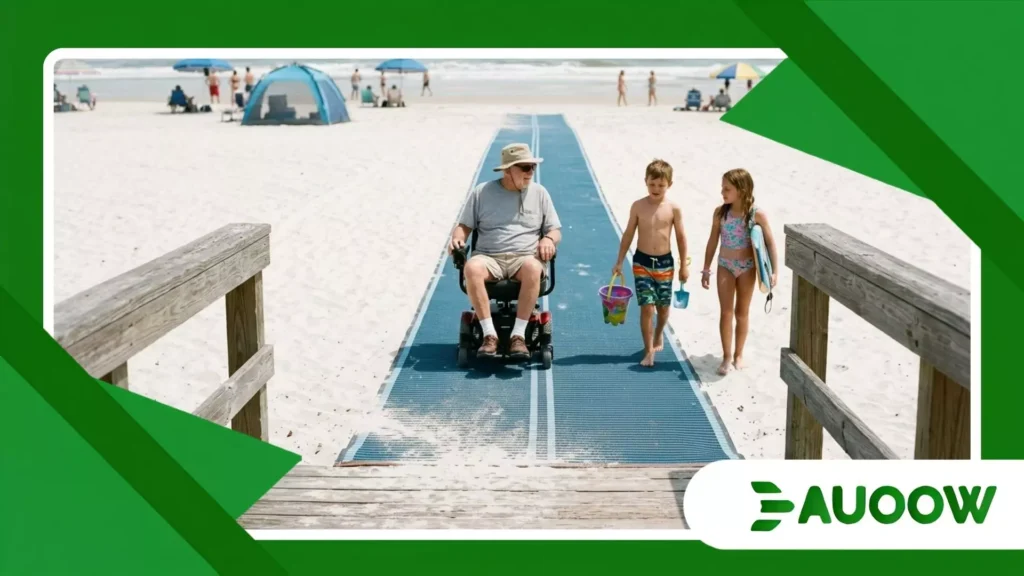
But watch what happens on a hot Saturday afternoon when a family arrives at the sea wall. A grandfather who uses a motorized wheelchair stops where the weathered wooden planks end and the soft, sinking white sand begins.
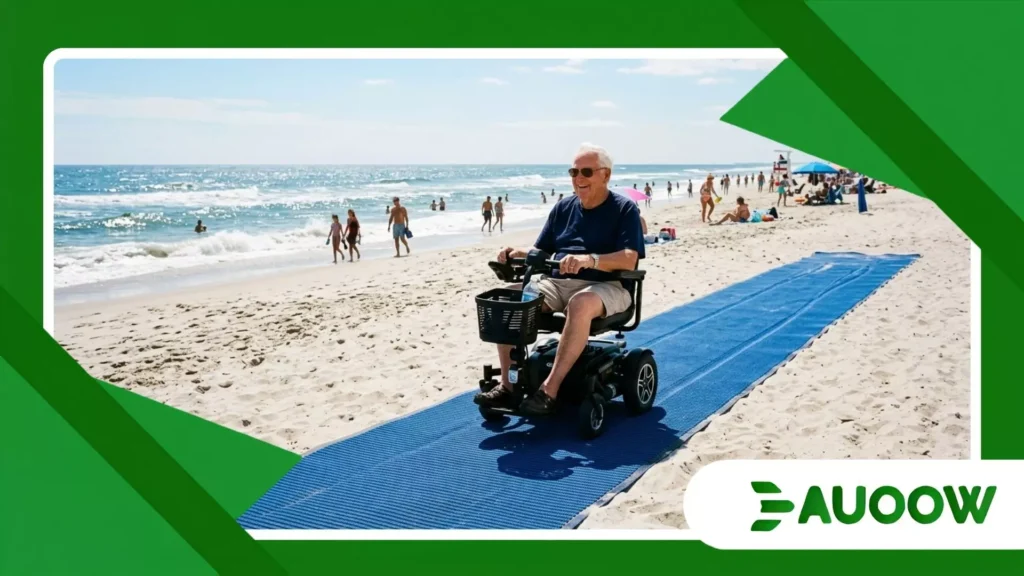
For years, this geographical boundary marked the end of his trip to the coast. Today, as his tires grip the textured rubberized pathway, he rolls down to the wet sand near the water’s edge, keeping pace with his grandchildren as they carry plastic buckets and boogie boards.
What looks like a simple addition to outdoor infrastructure actually reflects a fundamental shift in how civil engineering approaches public recreation.
The physical barrier between solid ground and shifting sand has long isolated people with physical disabilities from coastal environments.
Exploring these mobility pathways offers a clearer understanding of how practical design decisions can expand community access.
What You Will Find in This Analysis
- The Physics of Exclusion: Why coastal environments present unique design challenges.
- Structural Continuities: Connecting civil rights history with modern outdoor design.
- Beyond the Boardwalk: A real-world look at coastal municipal management.
- Systemic Realities: Maintenance, politics, and civic priorities evaluated side-by-side.
- Frequently Asked Questions: Clear answers regarding coastal accessibility initiatives.
- Rethinking Public Access: Moving from seasonal accommodations to universal rights.
Why Has the Ocean Shoreline Remained One of the Hardest Places for Accessibility Integration?
When we think about physical accessibility, our minds naturally drift to concrete sidewalks, curb ramps, elevator banks, and broad doorways.
These are controlled, static environments designed by architects who can predict load capacities, slip resistance, and weather degradation down to exact engineering tolerances. Sand, however, obeys entirely different physical dynamics.
In years spent tracking municipal infrastructure and disability policy, a clear pattern emerges: natural terrain is frequently cited as a justification for human inaction.
For decades, coastal park authorities viewed the beach as a naturally wild zone where standard accessibility guidelines simply could not apply.
Loose quartz sand creates high rolling resistance, causing manual wheelchair wheels to sink, caster wheels to swivel out of alignment, and heavy electric power chairs to dig themselves into immediate traction failure.
When communities install beach access mats, they are not altering the natural landscape; they are inserting a resilient, semi-flexible bridge over loose terrain.
These specialized pathways, typically fabricated from high-density woven polyester or recycled rubberized polymers, disperse weight across a wider surface area.
This engineered weight distribution allows mobility devices, strollers, and walkers to move across soft sand without sinking or getting stuck.
Yet the primary challenge was never purely mechanical; it was conceptual.
For generations, urban planners viewed nature recreation as an optional amenity rather than a public right.
When accessibility standards were drafted into municipal codes during the late twentieth century, built environments received strict mandates, while natural spaces were frequently granted sweeping exemptions under the rationale of environmental preservation or technical infeasibility.
++ Why Local Governments Play a Critical Role in Accessibility
How Did Past Policy Decades Shape the Beaches We Have Today?
To understand why a rollout pathway feels notable today, we have to examine the history of public space management over the past fifty years.
When foundational disability legislation was enacted across various nations throughout the 1970s and 1990s, the priority was clear: ensure people could enter government buildings, hospitals, schools, and workplaces.
That focus made practical sense at the time. Securing economic participation and fundamental civil rights took precedence over recreational leisure.
However, this created a policy division. City halls received concrete ramps, while coastal parks remained largely unchanged.
“There is a subtle structural oversight that routinely gets missed in civic planning: when access is limited strictly to places of work and survival, we implicitly communicate that leisure, landscape, and spontaneous community life belong only to the non-disabled.”
When we observe municipal budgets with a critical eye, the pattern repeats itself across decades.
Shoreline cities invested heavily in massive parking facilities, modern retail boardwalks, and commercial concessions, yet treated the pathway down to the water as an insurmountable technical barrier.
The introduction of semi-permanent beach access mats across European and North American coastlines over the past decade marked a quiet breakdown of that old mindset.
Civil engineers began realizing that accessibility did not require pouring thousands of tons of permanent concrete over fragile coastal dunes a process rightfully restricted by environmental protection laws.
Instead, adaptable, non-invasive technology could fulfill public access goals without harming sensitive coastal ecosystems.
Also read: Why facial recognition accessibility raises daily access concerns
What Happens When a Coastal Town Rethinks Its Waterlines?
Consider the municipal experience of a mid-sized coastal community that decided to audit its public beaches three years ago.
Like many seaside towns, local leadership assumed their facilities were fully accessible because they possessed designated parking stalls and accessible restrooms on the main promenade.
However, a detailed audit conducted alongside local disability advocates revealed a glaring gap: the journey ended sixty yards short of the water.
Wheelchair users could watch the ocean from behind a wooden guardrail, but they could not easily reach the shoreline or join family gatherings near the water.
Read more: The rise of smart crosswalk accessibility in urban mobility plans
The town council approved a pilot project purchasing portable beach access mats alongside all-terrain beach wheelchairs equipped with balloon tires. The operational shifts were immediate and instructive:
- Local families who had avoided seaside trips for years returned to the shoreline.
- Senior citizens and physical therapy groups utilized the firm pathways for low-impact outdoor movement.
- Tourism boards reported an unexpected rise in multi-generational family bookings.
The technical implementation was straightforward. The main hurdle was moving past long-standing administrative routines the quiet assumption that certain outdoor places are simply off-limits to specific bodies.
Balancing the Equation: Infrastructure, Environment, and Policy
Implementing outdoor accessibility solutions requires balancing civic budgets, environmental conservation, and maintenance schedules.
Below is a comparative breakdown of common coastal accessibility strategies implemented by municipal park departments today.
| Accommodation Method | Initial Capital Expense | Installation & Maintenance Needs | Ecological Impact on Dunes | Overall Independence Level for Users |
| Permanent Concrete Ramps | High | Low maintenance; high initial construction labor | High; alters coastal sand flow and dune ecosystems | High self-propulsion capabilities |
| Rollout Beach Access Mats | Moderate | Low installation complexity; requires regular surface sweeping | Low; non-invasive and easily stored in winter | High; provides a stable, continuous surface |
| All-Terrain Beach Wheelchairs | Low to Moderate | High management; requires staff allocation or storage lockers | None; low impact on natural sand | Medium; often requires attendant assistance |
| Elevated Wooden Boardwalks | High | Moderate; vulnerable to storm surges and wood rot | Moderate; requires structural pile driving | High; limited to elevated fixed tracks |
Rethinking the Shoreline as a Universal Public Space
When we look beyond the technical specifications of high-density polymers and anchor pins, the widespread adoption of beach access mats forces us to re-examine our collective definition of public infrastructure.
A society’s commitment to accessibility is rarely measured by grand speeches or formal legislative proclamations; it is revealed in the quiet, practical details of how we build the places where people gather.
For too long, public leisure spaces were treated as secondary considerations in the broader conversation about civil rights and universal design.
By viewing the shoreline through the lens of social inclusion, we begin to see that access to natural beauty, open horizons, and public recreation is deeply linked to human dignity, autonomy, and civic belonging.
The success of these pathways proves that technical complexity is no longer a valid excuse for exclusion.
As coastal communities adjust to changing demographics, aging populations, and evolving social expectations, installing adaptable, sustainable accessibility solutions moves from a novelty to a standard expectation.
The edge of the sand no longer needs to mark the end of the journey; with thoughtful design and sustained civic commitment, it becomes another step along a shared path that belongs equally to everyone in the community.
Ensuring that shared public spaces truly serve the entire public requires continuous evaluation, open dialogue with community members, and a willingness to invest in infrastructure that honors human diversity in all its physical forms.
Frequently Asked Questions
Do beach access mats work for all types of wheelchairs?
Most high-quality pathways accommodate manual wheelchairs, power wheelchairs, pediatric strollers, and personal mobility scooters.
However, heavy power chairs with narrow caster wheels may require higher-density woven mats to prevent minor surface sagging on very soft sand.
Are these pathways kept on the sand year-round?
In most coastal regions, municipalities deploy these pathways seasonally from spring through autumn.
Because high tides, winter storms, and severe coastal weather can shift sand and submerge materials, park staff roll up and store the pathways during offseason months to prevent damage and ecological disruption.
How do local governments protect dunes while installing access paths?
Modern access pathways lay directly on top of compacted sand without requiring deep structural footings, excavation, or concrete pouring.
This non-invasive design preserves natural sand dunes, protects coastal plant root systems, and complies with strict environmental protection standards.
Can a single person deploy a rollout beach pathway?
While large commercial sections connected together across wide stretches of shoreline require a small grounds crew to align and stake down securely, modular section rolls can be handled and maintained easily by two park employees using basic hand tools.
