
How Skills-Based Hiring Could Benefit Professionals with Disabilities
When Elena submitted her twentieth job application of the season, she knew better than to hold her breath. Still, the automated rejection email arrived in under four minutes, a stark reminder of how distant skills-based hiring can feel in an industry obsessed with conventional credentials.
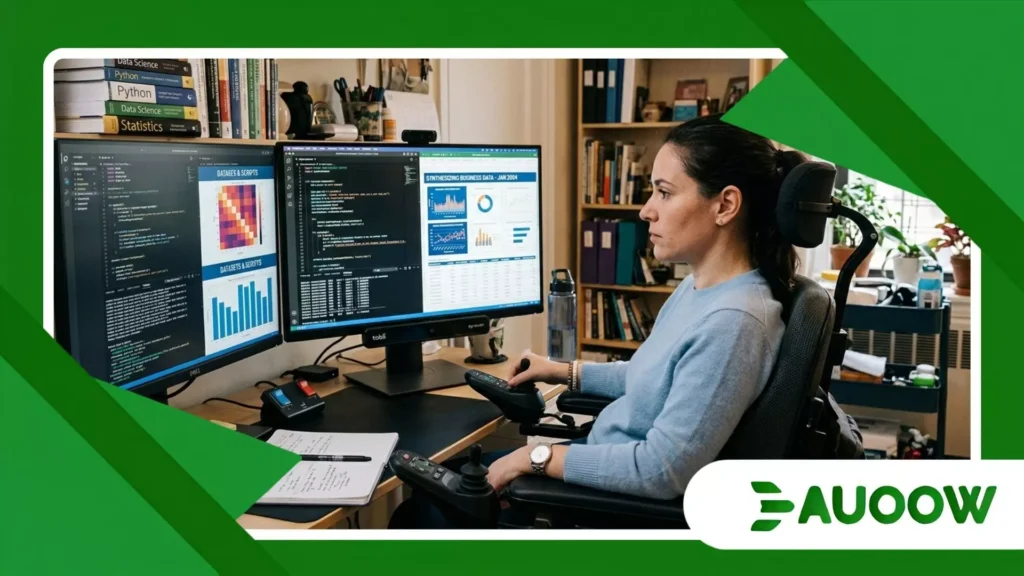
Elena is a talented data analyst with a severe motor impairment who relies on eye-tracking technology and customized macros to navigate complex datasets.
She writes Python scripts faster than most of her peers and synthesizes unstructured business data with clarity.
Yet, because her educational path involved non-traditional distance learning and because she lacked two consecutive years of traditional, full-time office attendance the algorithmic filters guarding corporate gateways repeatedly tossed her resume aside.
Stories like Elena’s are not rare edge cases; they represent the daily reality for millions of qualified individuals worldwide.
For decades, corporate recruitment systems have relied on proxy metrics: pre-selected university degrees, unbroken work histories, and rigid full-time schedules.
While designed to streamline recruitment, these filters effectively built invisible walls around capable candidates.
As organizations begin shifting toward skills-based hiring, we are witnessing a fundamental reassessment of how merit, capability, and potential are measured in the global workforce.
Key Takeaways in This Analysis
- The Structural Barrier: How traditional credentials and resume gaps systematically penalize disabled talent.
- The Shift in Methodology: Why evaluating verified competencies rather than pedigrees opens hidden talent pipelines.
- Historical Precedents: Connecting past legislative milestones with modern digital workplace accessibility.
- Real-World Evidence: Examining how competency-first recruitment operates in practical enterprise settings.
- Policy Comparison: Analyzing global frameworks and their direct impact on inclusive workforce practices.
- Editorial Perspectives: Frequently asked questions on implementing equitable evaluation standards.
Why Have Traditional Hiring Models Always Excluded Disabled Talent?
For generations, standard hiring relied on comfortable assumptions. Employers treated a four-year degree from a recognized institution as an unquestioned proxy for discipline, intellectual capacity, and technical skill.
They viewed uninterrupted employment timelines as proof of reliability and cultural fit.
What rarely enters this debate, however, is that these proxies were constructed within environments that were never designed to be accessible in the first place.
When an educational institution lacks accessible infrastructure, assistive digital tools, or flexible learning options, earning a traditional degree becomes a test of endurance through unnecessary friction rather than a simple proof of knowledge.
Similarly, when public transit systems or office buildings fail to accommodate mobility devices, maintaining a continuous in-person attendance record becomes an unfair measure of commitment.
Credential inflation disproportionately impacts marginalized groups.
When a role that previously required a high school diploma suddenly demands a bachelor’s degree, the barrier does not just rise it doubles for anyone whose educational or professional path was interrupted by systemic barriers.
Decoupling talent evaluation from where or how a skill was acquired helps dismantle the artificial prerequisites that keep capable disabled talent stranded outside the formal economy.
What Happens When We Look at Competency Instead of Pedigree?
In almost every sector, a familiar pattern emerges. A candidate presents an impressive portfolio of software development, digital marketing, or financial modeling skills.
Yet, during initial screening calls, the conversation subtly shifts from what they can build to how they will sit at a desk for eight consecutive hours or travel across town for quarterly meetings.
Evaluating actual competencies rather than superficial indicators shifts the focus back to productivity and practical problem-solving.
Consider an candidate who managed complex open-source software projects while navigating long-term medical recovery.
Under traditional scrutiny, their resume displays a three-year gap. Under a competency-first framework, their contributions to codebases, collaborative problem-solving, and mastery of asynchronous workflows take center stage.
This model naturally validates the adaptive strategies that disabled individuals develop in daily life.
Navigating a world built for standard body types demands ongoing adaptability, strategic resource management, creative troubleshooting, and deep familiarity with specialized assistive tools qualities that modern enterprises need but rarely know how to measure on a standard application form.
++ Why Workplace Onboarding Needs a Neuroinclusive Approach
How Do Historic Legislation and Modern Workplace Policies Intersect?

The movement toward inclusive employment is not a sudden trend; it is part of a longer civil rights struggle.
When the Americans with Disabilities Act (ADA) passed in 1990, followed by similar legal frameworks across Europe and the Commonwealth, the primary focus was physical integration: ramps, elevators, widened doorways, and basic non-discrimination protections.
Legal access to a building does not automatically guarantee equal entry into project teams or leadership pipelines. Standard employment contracts, rigid performance appraisals, and centralized office culture continue to shape contemporary hiring.
When statutory protections were first drafted, work was largely tied to physical presence and manual oversight.
Today, digital infrastructure allows work to be asynchronous, distributed, and output-oriented.
While legal protections successfully opened physical doors, many recruitment mechanisms remained tied to an era that prized uniformity over capability.
Adopting skills-based hiring aligns evaluation systems with the flexible digital realities of modern work.
Also read: How disabled founders can benefit from accessible procurement
What Does Competency-First Recruitment Look Like in Practice?
Consider a qualified graphic designer with a speech impairment applying for a role at a global media enterprise.
In a traditional interview format, heavy emphasis is placed on spoken fluency, rapid verbal negotiation, and spontaneous presentation under artificial pressure.
The candidate’s mastery of typography, visual hierarchy, user interface design, and layout architecture becomes secondary to how fluently they navigate a timed video call.
Now, imagine that same recruitment process reimagined through a practical, work-sample approach.
The candidate receives a realistic design brief, complete with brand guidelines and project constraints.
They complete the assignment within a flexible time window using their preferred software, assistive input devices, and personal workflow setup.
When the hiring committee reviews the submission, they evaluate:
- Spatial reasoning and layout structure
- Alignment with functional brand guidelines
- Accessible color contrast and file organization
- Clear written documentation explaining design choices
The evaluation centers on the deliverable. Technical mastery remains evident, quantifiable, and directly relevant to the actual demands of the job.
Read more: Robotics and Automation: Threat or Opportunity for Disabled Workers?
How Do Global Frameworks Compare in Supporting Inclusive Workplaces?
Nations use varied policy mechanisms to address the employment gap, ranging from legal mandates to flexible workforce initiatives.
| Policy Approach | Primary Mechanism | Impact on Disabled Talent | Structural Limitation |
| Quota-Based System (e.g., Germany, France) | Statutory mandates requiring companies to employ a fixed percentage of disabled workers. | Guarantees baseline headcount representation in large enterprises. | Risk of administrative compliance over genuine career progression. |
| Right to Request Adjustments (e.g., UK Equality Act) | Legal obligation for employers to provide reasonable workplace accommodations. | Empowers workers to request customized tools and flexible working patterns. | Relies on the candidate disclosing their disability during recruitment. |
| Competency-Focused Initiatives (e.g., US Public & Tech Sectors) | Removing degree requirements for public sector and tech roles in favor of skills testing. | Direct incentive for skills-based hiring, expanding entry points for non-traditional paths. | Requires internal HR teams to design unbiased skill assessments. |
While quotas mandate presence and accommodation laws reduce friction, competency-focused policies address a root cause of exclusion: how talent is identified and evaluated in the first place.
Redefining Capability for a Sustainable Workforce Future
Transforming recruitment from a system of rigid gatekeeping into an avenue of genuine opportunity requires more than updating corporate software or refreshing public messaging.
It demands a deliberate re-examination of what we truly value in the workplace.
For generations, organizations have confused formal credentials with actual capability, relying on convenient shortcuts that quietly filtered out resilient, talented, and highly skilled individuals simply because their professional journeys did not fit a standardized template.
Shifting toward skills-based hiring and evaluating real-world competencies is neither an act of charity nor a compromise on performance standards; it is a necessary structural correction.
When companies replace arbitrary filters with meaningful, output-focused assessments, they expand their candidate options while building operational environments that are inherently more flexible, innovative, and adaptable to human diversity.
True progress in workforce inclusion will not be measured by corporate pledges or seasonal awareness campaigns.
It will be measured quietly, day by day, in everyday hiring outcomes: when a data analyst like Elena is judged not by the gaps on her resume, her educational credentials, or how she navigates a room, but by the elegance of her code, the clarity of her technical insights, and the distinct value she brings to the team.
Frequently Asked Questions
What is the core principle behind skills-based hiring?
It is a recruitment methodology that evaluates applicants based on their demonstrated skills, technical abilities, and practical competencies rather than their formal educational degrees, previous employer prestige, or linear career trajectories.
How does this approach directly help job seekers with disabilities?
By focusing on practical performance and deliverables, it removes systemic barriers associated with resume gaps, non-traditional education paths, and rigid interview formats that frequently disadvantage disabled applicants.
Does removing degree requirements lower the quality of hires?
Evaluating candidates through practical work samples, skill tests, and project portfolios consistently leads to strong job performance, better retention rates, and access to a broader pool of qualified applicants.
How can employers ensure skill assessments are accessible?
Organizations design equitable assessments using universal design principles, providing flexible formats, supporting personal assistive technologies, offering asynchronous timeframes, and focusing on essential role functions.
