
Exporting Accessibility Laws: Do Western Models Actually Work Elsewhere?

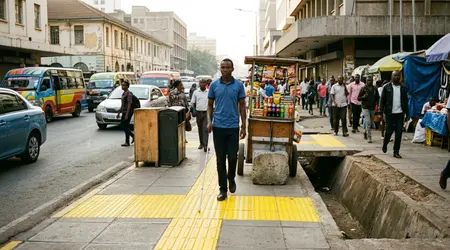
The morning heat in Nairobi’s Central Business District was already thick when I watched a young man named Samuel attempt to navigate a newly refurbished sidewalk.
On paper, this stretch of road was a triumph of modern urban planning, boasting bright yellow, tactile paving blocks imported directly from European design manuals.
In reality, the tactile path led Samuel, who is blind, directly into the concrete base of an illegally parked street-vending cart, and then abruptly terminated at a steep, open drainage ditch.
The Western blueprint had been meticulously replicated, yet the local reality rendered it not just useless, but dangerous.
When discussing how international frameworks travel, the practice of exporting accessibility laws is often hailed as a universal victory for human rights.
We tend to assume that if a piece of legislation works well in Washington, London, or Brussels, it should naturally become the gold standard for Kampala, Lima, or Jakarta.
But as Samuel’s daily commute demonstrates, legal texts rarely survive the journey across deep cultural and economic divides without fracturing.
Before we dissect why these statutory copies so often miss the mark, let us look at the core themes this editorial will explore:
- The Blueprint Fallacy: How legal borrowing ignores local infrastructure and informal economies.
- Historical Echoes: The colonial undertones of assuming Western civil rights models fit all societies.
- The Maintenance Gap: Why a lack of localized institutional memory leaves imported tech and infrastructure broken.
- A Shift to Context: Alternative approaches built on community-driven, culturally specific solutions.
Why do we assume Western legal frameworks fit everywhere?
There is a comforting, albeit lazy, paternalism embedded in global development circles.
For decades, the global North has viewed itself as the exporter of progress, assuming that the Americans with Disabilities Act (ADA) or the UK’s Equality Act 2010 are apex legal achievements to be emulated.
On paper, exporting accessibility laws seems like an efficient shortcut.
Why spend years debating national standards when you can simply adopt a battle-tested framework that has already stood the test of judicial scrutiny?
The illusion of the universal environment
What rarely enters this debate is that the ADA was designed for an exceptionally specific landscape.
It assumes a highly formalized economy, predictable municipal budgets, reliable electricity, and wide, gridded suburban and urban spaces.
When a middle-income or developing nation adopts these exact technical specifications, they are designing for a ghost city a place that does not exist within their borders.
In my reading of this scenario, we are witnessing a form of legislative vanity.
Governments can sign treaties, ratify conventions, and pass grand, sweeping accessibility acts modeled after Western templates to secure international approval or development loans.
Yet, when the ink dries, the structural reality remains untouched. The laws are passed, but the physical and social infrastructure remains stubbornly hostile.
++ Disabled People in Politics: Structural Barriers Beyond Discrimination
What happens when civil rights clash with collective cultures?
When we observe with more attention, the pattern repeats across Latin America and Sub-Saharan Africa.
Western accessibility laws rely heavily on strict enforcement mechanisms, corporate fines, and civil litigation.
If a supermarket in Chicago fails to provide an accessible ramp, a lawsuit follows. This system assumes that businesses are registered, fixed, and sensitive to legal liability.
“A law designed for a suburban American strip mall cannot regulate a bustling, fluid marketplace in Lagos or a hillside favela in Rio.”
The reality of fluid public spaces
Consider the nature of public space in much of the global South. Sidewalks are not just thoroughfares; they are marketplaces, social hubs, and informal bus stops.
An imported law dictating a clear, two-meter path of travel is functionally meaningless in a neighborhood where survival dictates that vendors use every inch of available pavement.
By centering the conversation entirely on exporting accessibility laws, international policymakers ignore the economic realities of the people who actually inhabit these spaces.
A disability rights framework that criminalizes or ignores the informal economy will inevitably fail both the disabled community and the wider public.
What happens when civil rights clash with collective cultures?
There is a subtle, structural detail that is often overlooked: Western disability legislation is deeply rooted in hyper-individualistic philosophy.
The goal of the ADA is independent living enabling a person to navigate the world completely on their own terms, free from reliance on others.
While this is an empowering ideal, it does not always map cleanly onto societies built around deeply entrenched collectivist values.
Also read: Disability Rights in Africa: Emerging Leaders in Inclusion
Reimagining interdependence over independence
In many cultures across Asia and Africa, well-being is viewed through the lens of community and family networks. Interdependence is not seen as a failure of accessibility, but as a cultural norm.
When Western models are exported wholesale, they often devalue these existing social safety nets in favor of rigid, bureaucratic accommodations that a state may have no capacity to provide.
The most honest analysis suggests that by focusing purely on legal rights rather than social solidarity, we risk importing the isolation that so often plagues disabled individuals in Western societies.
There are good reasons to question this approach, particularly when local, community-led care networks are dismantled or dismissed as “backward” simply because they do not match Western administrative metrics.
Read more: Accessibility Policies in India: Progress and Pitfalls
A Tale of Two Realities: The Legislative Implementation Gap
To understand how this disconnect manifests on the ground, it is useful to look at specific examples of how these policies falter or succeed when removed from their original environments.
The silent failure of low-floor buses
Imagine a wheelchair user in a major South American metropolis that recently invested millions in a bus rapid transit (BRT) system, modeled directly after European standards.
The buses feature low floors, automated ramps, and dedicated wheelchair bays. On paper, it is a triumph of equity.
In practice, the system breaks down before the passenger even reaches the bus stop.
The surrounding neighborhood has no curb cuts, the pavements are broken by tree roots, and the automated ramp mechanism on the bus stops working within three months due to a lack of imported spare parts.
The Western technology was purchased, but the local ecosystem required to maintain it was entirely ignored.
When local adaptation works
Conversely, consider how grassroots communities solve these problems when left to innovate outside the bounds of rigid Western templates.
In several rural districts in India, instead of waiting for expensive, standardized electronic screen readers or imported prosthetic devices, local mechanics and disabled-led organizations co-design low-cost, rugged mobility aids using bicycle parts and local materials.
Imported Western blueprints often treat accessibility as a luxury product to be purchased, rather than a community habit to be cultivated.
The table below highlights the practical divergence between the expectations of exporting accessibility laws and the ground realities in developing nations.
| Policy / Infrastructure Area | Western Design Assumption | Ground Reality in Developing Contexts |
| Urban Mobility | Paved, standardized sidewalks with tactile paving. | Mixed-use spaces, informal vending, unpaved roads. |
| Enforcement | Civil lawsuits, building inspectors, corporate fines. | Underfunded municipalities, informal economies. |
| Assistive Technology | High-tech, individualized devices (e.g., smart chairs). | Need for low-cost, locally repairable, rugged equipment. |
| Support Systems | State-funded personal assistants and institutional aid. | Heavy reliance on family, neighbors, and mutual aid. |
Why does the maintenance gap render imported laws useless?
The conversation around accessibility is too often dominated by the excitement of the “new” the launch of a new accessible subway line, the passing of a landmark bill, or the distribution of high-tech wheelchairs.
What happens five years later, however, is where the true story lies.
The graveyard of unmaintained technology
When we look at the long-term data, the strategy of exporting accessibility laws without exporting the accompanying industrial and economic infrastructure creates a graveyard of broken promises.
Elevators in train stations sit broken for years because local technicians lack the training or the parts to fix them.
Tactile paths are paved over during routine road repairs because local workers were never taught why those bumps in the concrete matter.
This is why treating inclusion as a static checklist is so dangerous. True accessibility is a living, breathing municipal habit.
It requires continuous investment, institutional memory, and local ownership elements that cannot be imported in a container or copied from a foreign legislative website.
How can we build an authentic, localized model of inclusion?
If the wholesale duplication of Western frameworks is flawed, the solution is not to abandon disability rights, but to decolonize how they are designed and implemented.
We must move away from the top-down imposition of foreign standards and begin listening to the nuanced realities of local disabled communities.
Co-designing with local realities
True progress happens when international human rights principles are translated into the local vernacular.
This means designing regulations that acknowledge informal economies, prioritizing low-tech but highly durable infrastructure, and respecting collective social structures.
Instead of focusing on exporting accessibility laws, the global community should focus on supporting local advocates who understand the unique friction points of their own cultures.
Only then can we move past the superficial mimicry of inclusion and begin building societies that are genuinely accessible to everyone, everywhere.
Editorial FAQ
Why don’t Western accessibility laws work in other countries?
They often fail because they assume an environment that doesn’t exist everywhere: paved sidewalks, steady electricity, formal business regulations, and high municipal budgets.
When these laws face informal economies or lack of maintenance infrastructure, they quickly break down.
Does this mean developing nations shouldn’t have accessibility laws?
Not at all. Every country needs strong protections for disabled citizens, but these laws must be designed around local economic, cultural, and geographic realities rather than being copied directly from Western templates.
What is an example of a Western model failing abroad?
An example is importing low-floor public buses with automated ramps into cities where the surrounding sidewalks are completely inaccessible, or where there are no local mechanics or spare parts available to fix the ramps when they break down.
How can accessibility be improved without relying on Western blueprints?
By focusing on community-led, low-cost, and durable solutions.
This includes designing infrastructure that accommodates informal street economies and co-designing mobility aids using locally available materials that can be easily repaired.
