
How hybrid learning accessibility affects disabled students outcomes
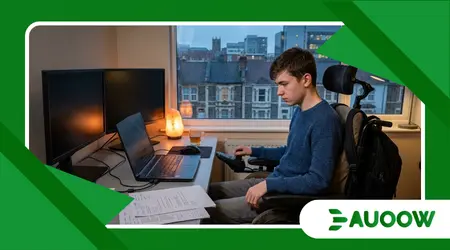
When the screen fades to black at the end of a three-hour seminar, Lucas doesn’t pack a physical backpack.
For this nineteen-year-old undergraduate, who navigates both a severe spinal cord injury and a demanding computer science curriculum from his home in Bristol, the conclusion of a lecture looks vastly different than it does for his peers.
There are no crowded hallways to navigate, no heavy fire doors to push open, and no steep lecture hall stairs to descend.
Yet, as the digital window closes, a different kind of isolation settles in.
The chat transcript disappears, the automated captions frequently mangled by technical jargon vanish, and the realization hits that while he was technically present, he was largely invisible to the seminar group.
It is precisely in these friction points where we observe how hybrid learning accessibility affects disabled students and their long-term academic growth.
Before diving deeper into this landscape, it helps to map out the distinct layers of the hybrid experience we will explore today:
The Shared Reality: Balancing digital presence with physical absence.
The Structural Barriers: Why modern software often mirrors ancient architecture.
The Policy Gap: How historical legislation fails to govern cloud-based classrooms.
The Path Forward: Moving past mere technical compliance toward genuine educational equity.
Why are we still treating digital access as an afterthought?
To understand why the digital environment remains so uneven, we have to look at how universities constructed their online infrastructure.
When educational institutions rapidly shifted toward split-delivery models over the last few years, the primary goal was continuity, not equity.
Software suites were adopted wholesale, often without rigorous audits from frontline accessibility specialists.
What rarely enters this debate is the fact that digital architecture behaves exactly like physical architecture.
When you build a lecture hall without a ramp, you make a conscious socio-economic choice about who belongs in that room.
When an institution deploys a learning management platform that lacks native screen-reader compatibility or fails to support keyboard-only navigation, the exact same choice is being made, wrapped in the language of technological progress.
When we observe with more attention, the pattern repeats across diverse academic landscapes.
We see millions poured into state-of-the-art campus buildings, while the online portals housing assignments, grades, and peer discussions remain clunky, unvetted, and largely hostile to assistive technologies.
The underlying assumption is that digital access is a luxury or a temporary alternative, rather than a permanent, fundamental pillar of modern higher education.
This foundational oversight in how hybrid learning accessibility affects disabled learners forces them to spend more energy on fighting the interface than engaging with the curriculum.
++ The impact of edtech regulation schools on inclusive education access
What actually changed after this?
To grasp the distance between institutional rhetoric and the daily reality of students, it is useful to look at the tangible shifts that occurred when universities institutionalized these blended formats.
| Area of Impact | The Institutional Promise | The Lived Reality in the Classroom |
| Schedule Flexibility | Students can self-pace their learning to accommodate health fluctuations or therapy schedules. | Deadlines remain rigid, and asynchronous materials are frequently uploaded without captions or transcripts. |
| Physical Relief | Reduced commuting times lower fatigue and minimize physical barriers inherent in older campuses. | Digital fatigue intensifies due to poorly formatted interfaces and lack of built-in breaks during long streams. |
| Peer Interaction | Collaborative digital tools democratize participation for non-verbal or anxious students. | Breakout rooms often isolate remote disabled students, leaving them disconnected from the main physical classroom cohort. |
| Assessment Delivery | Online examinations offer a more comfortable, customizable environment for testing. | Automated proctoring software frequently flags atypical movements or screen-reader usage as suspicious behavior. |
How do historical policies shape today’s virtual classrooms?
We often talk about digital inclusion as if it were an entirely new frontier, a blank slate born in the laboratory of the twenty-first century.
This is a comforting myth, but an inaccurate one. The barriers Lucas faces every Tuesday morning are deeply connected to decisions made decades ago.
When foundational pieces of legislation like the Americans with Disabilities Act (ADA) in the United States or the Disability Discrimination Act in the United Kingdom were drafted, the internet was an experimental network, not the primary infrastructure of human life.
These early laws were conceptualized around concrete, brick, and mortar.
They were designed to ensure that a person in a wheelchair could get through the front door of a library, not to guarantee that the digital PDF they downloaded inside was properly tagged for a screen reader.
Consequently, universities have spent decades cultivating an administrative culture focused on physical compliance.
They know exactly how many inches wide a doorway must be, yet they remain profoundly bewildered by the Web Content Accessibility Guidelines (WCAG).
This legal and cultural lag explains why hybrid learning accessibility affects disabled individuals so unevenly today.
The old compliance mechanisms simply cannot keep up with a classroom that exists simultaneously in a lecture hall and on a server cloud.
When a professor uses a digital whiteboard during a live stream but forgets to verbally describe the diagrams being drawn, they are not intentionally discriminating.
They are operating within a systemic blind spot created by an educational culture that has never fully integrated digital equity into its core definition of teaching.
Also read: Inclusive Education in the Middle East: Emerging Opportunities
Is technical accommodation the same as true inclusion?

There is a structural detail that is often overlooked within university administrations: the vast difference between an accommodation and design equity.
An accommodation is reactive. It requires the student to register their diagnosis, submit documentation, wait for approval, and then hope that an individual instructor remembers to provide extended time or closed captions.
It places the entire emotional and bureaucratic burden directly on the person who is already navigating an environment not built for them.
Design equity, or universal design, operates on the opposite premise. It assumes from the very first line of code or course syllabus that a diverse student body will use the material.
In a universally designed hybrid course, every video is captioned by default, every document is screen-reader friendly, and every assignment offers multiple ways to demonstrate mastery.
Looking closely at this scenario, the heavy reliance on individual accommodations rather than systemic design is a primary reason why the conversation around mixed educational models has stalled.
We are trying to patch a fundamentally inaccessible framework with endless streams of paperwork, instead of rebuilding the framework itself.
When an institution fails to make this shift, the resulting cracks in how hybrid learning accessibility affects disabled retention rates, mental health, and final grade averages show up far more than academic administrators care to admit.
Read more: Africa’s Innovative Approaches to Inclusive Learning
What happens when the social fabric of education fractures?
Imagine a graduate student preparing for a high-stakes seminar. They have a brilliant mind, an impeccable research record, and a profound hearing loss.
In a physical classroom, they might use a high-quality FM system or rely on a dedicated sign-language interpreter positioned next to the speaker.
Now place that same student into a split environment where half the class is in a room with poor acoustic design and the other half is on a grid of muted video squares.
The remote student misses the side conversations, the subtle shifts in tone, the laughter that builds camaraderie, and the spontaneous debates that happen when two people talk over each other in excitement.
The automated transcription software changes complex philosophical terms into gibberish. The instructor, busy managing the physical room, rarely glances at the digital hand-raise icon on their screen.
An honest analysis suggests that the loss here is not merely academic; it is profoundly social.
Higher education is not just an information delivery system; it is a collaborative community where professional networks are formed, confidence is built, and identities are explored.
When a blended learning environment treats remote participants as passive spectators rather than active contributors, it robs them of the informal interactions that define the university experience.
This subtle, everyday marginalization illustrates how deeply hybrid learning accessibility affects disabled outcomes over an academic career.
Moving past compliance toward empathy
There are good reasons to question the current metrics used to measure university success in this area.
Right now, an institution can check every legal box, pass its audits, and still leave its disabled student body feeling completely isolated and exhausted.
True accessibility cannot be measured solely by software licenses or accessibility statements hidden in the footer of a website.
It is found in the lived experience of students who no longer have to ask for permission to participate.
The path forward requires us to stop looking at accessibility as a series of technical chores to be completed by an underfunded IT department.
It must become a core pedagogical value, as fundamental to course design as the selection of textbooks or the hiring of faculty.
Only when we view the virtual space with the same ethical gravity we apply to physical spaces can we hope to build an educational system that honors its promise of universal opportunity.
FAQ Editorial
How exactly does poor digital formatting influence a student’s daily study time?
When course materials are not formatted correctly, students using assistive technologies like screen readers must spend hours fixing files or using workaround software just to read an assignment.
This administrative burden means they have significantly less time to actually study the content compared to their peers, leading to academic fatigue and lower performance.
Why do automated captions often fall short in high-level university courses?
Automated captioning systems rely heavily on standard vocabulary algorithms.
In specialized university seminars, professors regularly use complex terminology, unique names, and historical references that these systems frequently misinterpret.
Without manual review or professional captioning services, these errors make lectures confusing or entirely unreadable for deaf or hard-of-hearing students.
Can a student be legally protected under physical campus rules while remaining unprotected online?
Yes, because many older disability rights laws focus heavily on physical modifications like ramps, lifts, and accessible restrooms.
While digital accessibility regulations are catching up, many institutional frameworks still lack clear, enforceable standards for third-party software, online portals, and asynchronous video content used in hybrid education.
What simple changes can an instructor make today to improve a blended classroom environment?
Instructors can immediately improve their classes by descriptive speaking verbally explaining any slides, diagrams, or visual aids used during a lecture.
Additionally, ensuring all digital readings are uploaded as selectable text PDFs rather than flat image scans allows screen-reading software to function properly from day one.
