
Why Accessible Digital Identity Systems Matter
When a municipal government in Western Europe transitioned its primary civic services to a unified online portal, local officials celebrated the milestone as a triumph of modern public administration.
The promise was seamless efficiency: citizens could now renew driver’s licenses, apply for housing subsidies, request tax records, and register to vote from the comfort of their homes.
Yet within forty-eight hours of launch, a resident who relies on screen-reading software found herself locked out of her citizenship records, unable to navigate a biometric facial recognition step that required rapid eye movement within an unannounced three-second window.
Accessible digital identity systems are designed to prevent exactly this kind of systemic barrier, ensuring that as public infrastructure moves online, fundamental civil rights remain usable for everyone.
What rarely enters the mainstream conversation around government technology is that digital identity is no longer merely a convenience; it serves as a primary access point to modern society.
When an authentication layer fails a user with a disability, it does not just cause mild frustration.
It effectively restricts their access to essential services, banking, healthcare, and democratic participation.
What We Will Explore
- The Civil Rights Dilemma in Digital Authentication: How identity verification systems inadvertently erect new physical and technical barriers.
- Structural Roots of Digital Exclusion: The technical design choices that shaped current identity standards.
- Real-World Impact: What happens when an authentication workflow encounters the reality of human diversity.
- Architectural Principles for Inclusion: How engineers and policymakers can build systems that verify identity without excluding people.
- Frequently Asked Questions: Practical insights on digital identity, privacy, and international accessibility standards.
Why Is the Gateway to Public Services Closing for Millions?
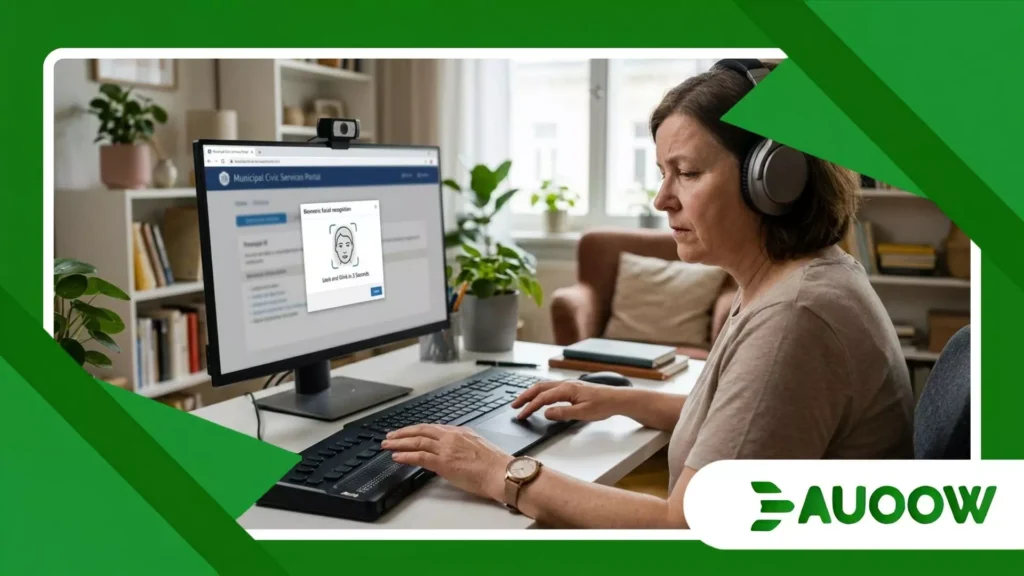
Consider the mechanical reality of standard digital verification today.
To prove your identity to a government agency or financial institution, you are frequently asked to hold a smartphone at arm’s length, line up your face within an oval outline on a glare-prone screen, and perform a series of quick physical actions smiling, blinking, or turning your head toward a flashing light.
For someone with motor tremors, visual impairments, or neurological conditions that affect facial movement, this sequence presents significant obstacles.
The software often interprets a trembling hand or an unblinking gaze not as human variation, but as potential fraud.
Security protocols are routinely built around a narrow physical standard. When identity engineers design fraud prevention mechanisms, they often define valid human behavior through rigid physical tolerances.
| Verification Approach | Design Focus | User Impact |
| Traditional ID Systems | Single verification path with rigid physical tolerances. Assumes uniform physical and cognitive abilities. | High risk of lockout; forces reliance on physical offices or third-party proxies. |
| Accessible ID Systems | Multiple authentication pathways with adaptive biometric thresholds. Respects diverse human traits. | Universal fallbacks, preserved privacy, and independent management of personal credentials. |
When authentication mechanisms enforce these narrow physical expectations, access becomes a matter of civil rights.
If a citizen cannot prove who they are through an online portal, they are frequently redirected to physical offices that may lack accessible transit, or forced to share sensitive personal credentials with third-party proxies, surrendering their autonomy in exchange for basic access.
How Did Past Verification Practices Shape Today’s Digital Barriers?
The challenge of proving identity did not start with the internet.
For generations, public institutions relied on physical artifacts signatures, paper certificates, embossed seals, and photographs to authenticate individuals.
While those traditional systems had their own accessibility limits, they included an element that digital systems often lack: human discretion.
A clerk at a local registry office could look at an individual, review physical documents, listen to an explanation, and exercise judgment to confirm an identity.
When public policy began digitizing identity verification in the early 2000s, the primary goal was reducing administrative overhead and processing delays.
However, in replacing human interaction with automated algorithmic checks, systems lost the capacity for contextual understanding.
Early web standards prioritized backend encryption and database efficiency, while user interface flexibility received limited attention.
Accessibility was frequently treated as a secondary feature something to be patched later through external scripts or separate phone lines rather than built into the core architecture.
Because many identity architectures were constructed without universal design in mind, modern platforms inherited structural flaws.
They often assume every user possesses stable motor control, typical cognitive processing speeds, standard vision, and access to modern hardware with high-resolution cameras.
Without intentional updates, security enhancements risk widening the gap between those who can easily verify their identity and those who are locked out of digital citizenship.
++ The Growing Push for Accessible Government Websites
What Happens When Authentication Encounters Real Human Diversity?
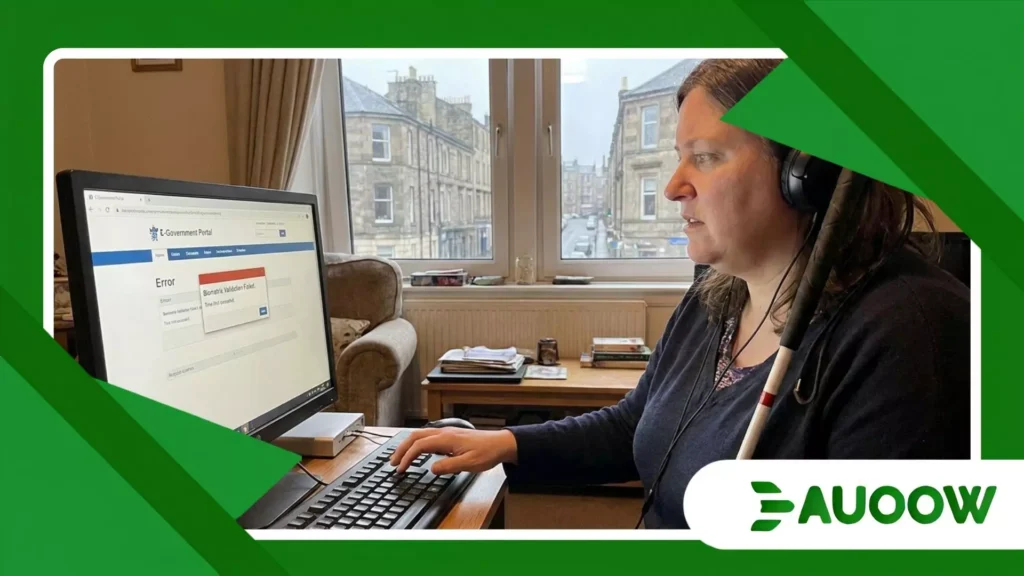
To understand how identity barriers operate in practice, consider a university graduate with cerebral palsy applying for a national support grant through a modernized state portal.
The platform requires a multi-factor authentication setup involving two sequential steps: entering a temporary passcode sent via SMS within ninety seconds, followed by a live video capture to verify the applicant against a government-issued photo ID.
When the applicant attempts the process, several systemic friction points occur at once:
- The ninety-second countdown timer does not accommodate the extra time needed to switch between an SMS application and the browser using assistive switch devices.
- The facial recognition algorithm flags the live video capture as invalid because involuntary muscle movements prevent the camera from achieving a stable image frame.
- The automated system interprets these delays as suspicious activity, locking the account and directing the user to a phone helpline.
- The helpline relies on an automated voice response system that requires rapid numerical keypad input, creating an additional barrier for the user’s input equipment.
This scenario illustrates that inaccessible identity systems rarely fail gracefully.
Instead of offering a immediate, dignified alternative, they trigger security countermeasures that treat assistive navigation as a potential threat.
The applicant was not excluded by a personal limitation, but by system design choices that equated physical variance with security risks.
Also read: Why disability voting access is a major issue in 2026 elections
How Can Engineers Build Truly Inclusive Verification Platforms?
Building identity infrastructure that respects human diversity does not require compromising security or accepting higher rates of fraud.
Flexible, multi-modal authentication design often makes platforms more resilient against broader systemic vulnerabilities.
When designing inclusive systems, engineering teams and public policy planners can implement several foundational strategies:
Read more: Exporting Accessibility Laws: Do Western Models Actually Work Elsewhere?
Alternative Authentication Channels
No single verification method works for every individual. Inclusive systems offer equivalent, equally secure verification paths.
If a biometric check is required, users should be able to choose between facial recognition, voice verification, hardware security keys, or cryptographic digital credentials without facing administrative delays.
Flexible Session Timing
Unadjustable countdown timers remain a frequent cause of authentication failure for people using assistive technology.
Systems should allow users to request extended session times or adjust timeout settings when safe fallback verification mechanisms are active.
Adaptive Biometric Thresholds
Biometric algorithms need to accommodate natural physical variations, tremors, and facial asymmetry.
Rather than terminating a session when a scan is imprecise, systems can offer adaptive capture settings or transition the user smoothly to an alternative secure channel.
Alignment with Universal Design Standards
Identity platforms must conform to global accessibility standards, such as the Web Content Accessibility Guidelines (WCAG) 2.2 Level AA, ensuring full compatibility with screen readers, keyboard-only navigation, and external switch controls.
Transitioning to inclusive architecture demonstrates that removing technological barriers strengthens system integrity.
By creating flexible, dignified pathways to digital identity, public institutions ensure that the digital front door remains open to everyone.
Frequently Asked Questions
What does an accessible digital identity system mean in practice?
It refers to identity verification platforms designed so that people with visual, auditory, motor, or cognitive disabilities can prove their identity independently.
This includes compatibility with screen readers, flexible biometric options, adjustable session timers, and alternative verification channels.
Do flexible identity systems reduce security or increase fraud risks?
Designing for accessibility does not mean lowering security standards. It involves providing multiple, equally secure methods for users to prove their identity.
Multi-modal options lower security risks by reducing the need for individuals to share passwords or personal credentials with third parties to navigate inaccessible portals.
Why do standard biometric systems present barriers for some users?
Standard biometric mechanisms frequently rely on specific physical traits or rapid actions, such as unblinking eye alignment, precise hand placement, or rapid head turns.
Individuals with tremors, facial paralysis, or visual impairments may be incorrectly flagged by rigid recognition algorithms.
How do global guidelines apply to identity platforms?
Frameworks like the Web Content Accessibility Guidelines (WCAG) set technical parameters for digital accessibility, including requirements for screen reader support, keyboard navigation, contrast ratios, and timing adjustments.
Modern identity platforms apply these standards to align with civil rights and digital governance mandates.
How can organizations update their existing verification flows?
Organizations can begin by evaluating their current verification steps alongside users of assistive technology, introducing alternative verification paths, removing rigid session timers, and ensuring all third-party identity software meets WCAG 2.2 Level AA standards.
