
Accessibility in Public Libraries: Policies That Make a Difference
When you step through the heavy doors of a city branch on a Tuesday afternoon, true accessibility in public libraries isn’t merely about a concrete ramp anchored to the side entrance.
It is about whether the world inside actually recognizes your right to seek knowledge without asking for permission or navigating unnecessary hurdles.
A retired machinist with progressive vision loss stands near the circulation desk, running his fingers along the edge of a computer terminal.
He isn’t looking for help to read his email he is looking for the screen-reading software promised on the municipal website, only to find the station locked behind an administrative password that the afternoon staff member doesn’t know how to bypass.
Across the room, a parent pushing a heavy motorized wheelchair maneuvers through a labyrinth of low-hung display racks.
The building technically complies with local building codes, yet the space between the non-fiction shelves narrows just enough to turn an autonomous visit into a series of awkward compromises and forced detours.
These quiet friction points reveal the distance between symbolic compliance and actual usability.
Public reading rooms have long claimed to be open democratic spaces, but many of their architectural and operational foundations were laid in an era that viewed accommodation as a charity rather than a fundamental civic right.
What Will You Discover in This Analysis?
- The Evolution of the Reading Room: How historic architecture quietly codified exclusion and why modern retrofits often fall short.
- Beyond Physical Ramps: The shift from physical entryways to digital interfaces, assistive software, and adaptive catalogs.
- Policy vs. Practice: Why statutory compliance doesn’t automatically translate to an inclusive daily experience.
- Comparative Policy Impact: A structured look at how specific regulatory frameworks shape physical and digital access.
- The Cost of Friction: How systemic oversights affect patrons, staff, and community trust over time.
- Frequently Asked Questions: Direct answers regarding rights, funding, and modern accessibility standards.
Why Do Ancient Architectural Choices Still Dictate Who Gets Inside?
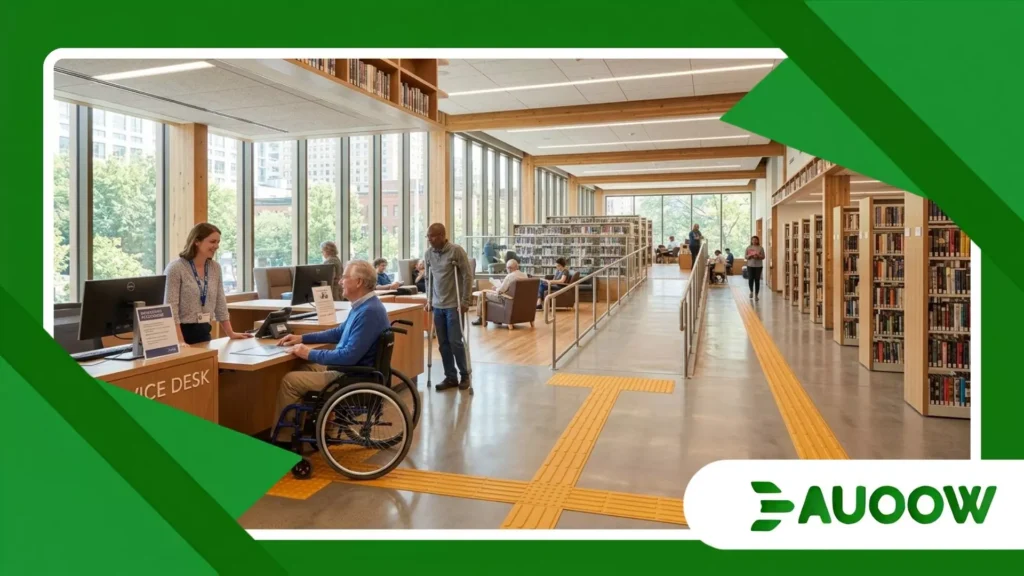
To understand why many municipal branches struggle with inclusion today, we have to look at the intentions embedded in their original stone foundations.
During the late nineteenth and early twentieth centuries, public reading halls were designed as monuments to civic virtue.
Grand stone staircases were deliberately built to elevate the institution above the noise of the street, signaling intellectual prestige and moral authority to everyone who passed by.
What rarely enters this debate is how those elevated steps functioned as an immediate physical filter.
They made entry inherently difficult for anyone with mobility impairments, chronic pain, or physical fatigue, setting a precedent that physical effort was required for entry.
When civic leaders eventually began addressing accessibility in public libraries, they treated old infrastructure as a nuisance to be patched rather than a fundamental design failure.
They added side-door ramps near loading docks, tucked platform lifts into hidden corridors, and created alternative entrances that felt more like service deliveries than dignified arrivals.
There is a structural detail here that often gets overlooked: when an accessible entrance isolates a patron from the main lobby, it preserves the physical barrier as a social distinction.
It tells the community that while everyone may enter, we do not all enter through the same front door or share the same initial experience of the space.
The Two Faces of Compliance
- Historic Design Assumptions: Elevated steps designed as prestige symbols; isolated side-door ramp access; fixed-height wooden oak desks; physical card catalog dominance.
- Modern Universal Design: At-grade street entrance for all visitors; integrated main entrance traffic flow; height-adjustable workstation surfaces; screen-reader friendly digital catalogs.
How Did Early Legislation Shape Our Current Expectations?
Statutory milestones forced municipalities to confront physical exclusion through legal mandates and baseline requirements.
These legal frameworks established standards for doorway widths, turning radiuses, and restroom grab bars.
They transformed public spaces by giving patrons a formal mechanism to demand physical entry and baseline accommodations.
Yet, legal minimums often became maximum targets rather than starting points.
Municipalities routinely checked the boxes required to avoid legal issues while ignoring how those elements functioned together in daily life.
Early policy focused heavily on physical presence while missing the subtler mechanics of institutional participation.
Getting a person inside the door was treated as the end of the obligation, rather than the prerequisite for equal service, meaningful engagement, and independent use.
++ Why Accessible Housing Policies Need a Long-Term Vision
What Happens When Digital Catalogs Replace Physical Shelves?
As collections migrated from physical card trays to digital databases, the nature of exclusion underwent a quiet, profound transformation across institutions.
Digital search tools were celebrated as democratic breakthroughs that would allow anyone to browse collections from anywhere.
However, early digital interfaces were frequently built without structured screen-reader compatibility, proper keyboard navigation, or clear alt-text metadata for archived documents.
When we observe this shift closely, the pattern repeats across public infrastructure.
The assumption that modern technology automatically solves human access issues frequently masks the creation of entirely new digital barriers.
For a patron who relies on adaptive software, an inaccessible online catalog is the modern equivalent of a locked front door.
If an e-book platform licenses titles that cannot render text-to-speech, the library has effectively purchased a collection that excludes part of its community.
Why Is Assistive Software Still Treated as an Afterthought?
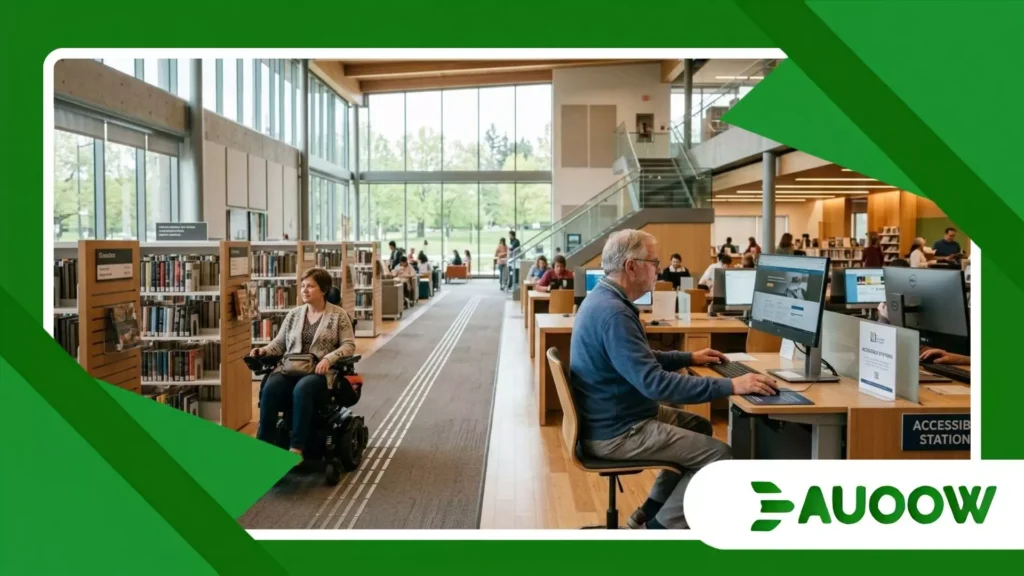
In many municipal branches, assistive hardware sits on a single dedicated terminal tucked away in a quiet corner.
This isolation creates practical breakdowns. If that specific computer is out of service, or if the single staff member trained on its software is off duty, accessibility in public libraries degrades instantly into an apology and a promise to check back next week.
True institutional integration requires that adaptive tools from screen magnification to tactile keyboards are maintained across general workstations rather than quarantined on specialized hardware.
Technology fulfills its civic promise when it is embedded into general maintenance budgets, staff training schedules, and software procurement contracts as a non-negotiable operational requirement.
Also read: The impact of assistive technology rights on public healthcare
Who Really Benefits When Policies Shift from Mandates to Mindsets?
When municipal leadership redefines access as a core operational strategy rather than a legal liability, the benefits spill far beyond the specific user groups targeted by legislation.
A ramp built for a wheelchair user serves a parent pushing a double stroller, a delivery worker hauling heavy book crates, and an older patron recovering from joint surgery.
Similarly, clear high-contrast signage, acoustic dampening panels, and intuitive floor layouts assist neurodivergent individuals, non-native language speakers, and patrons experiencing cognitive fatigue.
Universal Design in Public Spaces
- Wheelchair Users: At-grade entryways and lowered service counters.
- Parents & Strollers: Wide aisles and smooth, step-free ramps.
- Cognitive & Aging Patrons: Clear signage, intuitive layouts, and reduced background noise.
Can Staff Training Accomplish What Infrastructure Cannot?
Policy on paper means very little if the daily culture inside the reading hall remains rigid or uninformed.
Imagine a patron with an invisible disability or sensory processing sensitivity trying to use a crowded computer lab.
If staff members treat distress or non-traditional social cues with suspicion, the physical layout of the building becomes secondary.
Frontline workers require training that goes beyond memorizing emergency evacuation procedures.
They need a practical understanding of neurodiversity, adaptive communication techniques, and the confidence to troubleshoot assistive technology on the spot.
When staff members are equipped to handle diverse needs calmly and respectfully, the library transforms from a rigid administrative building into a responsive community hub.
Read more: The Future of Accessible Public Transportation Policies
How Are Local Communities Enforcing Real Structural Change?
Real progress rarely originates inside administrative boardrooms; it is pushed forward by grassroots advocates, community advisory groups, and patrons who demand better from their local tax-funded institutions.
In several urban districts, library boards now include seats for disability advocates who review renovation plans, software licenses, and programming budgets long before contracts are signed.
This structural shift ensures that accessibility isn’t evaluated after a building is finished, but integrated into every drafting phase, budget line, and software procurement draft.
What Does Policy Applied in Practice Look Like?
Consider the practical implementation of sensory-friendly hours in medium-sized suburban branches.
By dimming harsh fluorescent lighting, reducing volume levels on public terminals, and establishing designated quiet zones, branches open their doors to families who previously avoided public spaces entirely due to sensory overload.
This adjustment requires minimal capital expenditure, yet it expands institutional access for hundreds of residents who had been effectively excluded by standard operating procedures.
It demonstrates that accessibility in public libraries is often a matter of creative operational policy rather than multi-million-dollar architectural overhauls.
Policy Evolution and Institutional Outcomes
The following comparative table illustrates how public library policies, physical layouts, and digital infrastructure have shifted from historic baseline standards to modern universal design practices, along with the real-world civic impact of these changes.
| Policy Domain | Historical Baseline | Standard Legal Compliance | Modern Universal Design Practice | Real-World Civic Impact |
| Physical Entrance | Grand staircases; no alternative routes available. | Retrofitted side-door ramps or secondary platform lifts. | At-grade street-level entrances integrated for all patrons. | Eliminates social stigma and provides equal, dignified entry. |
| Digital Catalog (OPAC) | Physical card catalogs in deep, high-walled wooden drawers. | Basic web search portals lacking screen-reader support. | Fully accessible, WCAG-compliant digital systems with alt-text. | Allows independent research and resource discovery for visually impaired patrons. |
| Assistive Technology | Non-existent; reliance on personal companions or staff favors. | A single, isolated computer terminal with specialized software. | Adaptive software pre-installed across all public workstations. | Normalizes tool usage and ensures continuous service availability. |
| Staff Training | Focus on cataloging rules and quiet discipline enforcement. | Minimal awareness of basic statutory legal requirements. | Comprehensive training in neurodiversity and adaptive technology. | Creates a welcoming, non-judgmental atmosphere for diverse patron needs. |
| Collection Formats | Standard print books and static reference materials only. | Limited large-print sections and physical audiobook cassettes. | Integrated digital audio, synchronized e-books, and braille materials. | Expands literacy and lifelong learning access across diverse cognitive profiles. |
Reimagining the Public Library as a Catalyst for Social Equity
The journey toward full civic inclusion is neither linear nor complete.
While modern building standards and digital mandates have eliminated many of the most obvious physical barriers, true equal access requires continuous vigilance, honest self-assessment, and sustained investment from community stakeholders and municipal leaders alike.
Public libraries remain one of the few surviving non-commercial spaces in modern society where a person can enter without the expectation of spending money or justifying their presence.
Because of this unique position, they bear a heavy responsibility to set the gold standard for public accessibility across all aspects of their operations.
When we treat accessibility as an ongoing conversation between institutions and the communities they serve, we move far past superficial compliance and legal checklists.
We begin to build public spaces that do not merely tolerate human diversity, but actively honor it as a foundational strength of shared democratic life, ensuring that every patron can pursue knowledge with independence and dignity.
Building an inclusive library system requires us to re-examine every operational choice, from the height of a service counter to the procurement of digital databases and the ongoing education of frontline staff.
True access is created in the daily interactions between patrons, physical spaces, and administrative policies that prioritize human dignity over institutional convenience.
When municipal spaces embrace this principle, they fulfill their promise as genuine community hubs open to everyone.
Editorial Frequently Asked Questions
How do federal laws apply to public library systems?
Public access statutes require libraries operated by local governments to provide equal access to their programs, services, and facilities.
This means removing physical barriers where feasible, offering reasonable accommodations, and ensuring that digital resources and communications are accessible to individuals with diverse needs.
What should a patron do if an online library catalog is inaccessible?
Patrons can contact the library’s administration or accessibility coordinator to request an alternative accessible format or report the barrier.
Public institutions are expected to provide auxiliary aids and work toward making their digital infrastructure compliant with recognized standards like WCAG.
Are public libraries required to offer all books in audio or braille formats?
While libraries are not expected to hold every title in every format, they are responsible for providing reasonable access to their overall collection.
This is accomplished through interlibrary loans, digital lending platforms with built-in accessibility features, large-print collections, and partnerships with specialized network services.
How can sensory-friendly initiatives help neurodivergent patrons?
Sensory-friendly initiatives modify environmental factors such as lowering lights, muting system sounds, and providing quiet spaces to reduce sensory overload.
These adjustments make the library environment comfortable for individuals with autism, sensory processing conditions, or high anxiety.
What is the role of Universal Design in modern library architecture?
Universal Design is an architectural and operational philosophy aimed at creating spaces, tools, and services that are inherently usable by all people, to the greatest extent possible, without the need for adaptation or specialized retrofitting.
It moves beyond basic legal compliance to prioritize seamless, shared experiences.
How do budget constraints affect accessibility upgrades in older branches?
Older facilities often face financial hurdles when retrofitting historic buildings.
However, many meaningful improvements such as staff training, digital catalog adjustments, clear signage, and sensory-friendly hours require minimal funding and can be implemented while long-term capital campaigns raise funds for major structural renovations.
