
The Growing Role of Universal Design for Learning in Modern Schools
The implementation of universal design for learning in modern schools often begins not with a grand policy declaration, but with a quiet moment of frustration at a third-row desk.
Eleven-year-old Maya sits with a printed history worksheet in front of her, her pencil hovering over dense paragraphs that seem to blur under the harsh fluorescent lights.
She understands complex historical narratives when she listens to podcasts or watches documentaries at home, yet on paper, her severe dyslexia transforms a simple reading assessment into an insurmountable fortress.
Her teacher, witnessing this disconnect day after day, realizes that the issue was never Maya’s cognitive capacity; it was the rigid, single-pathway architecture of the assignment itself.
Key Perspectives in This Article
- The Core Shift: Moving from individual accommodations to proactive curriculum design.
- Structural Roots: How industrial-era schooling created today’s learning barriers.
- Real-World Impact: Lessons from public school systems implementing flexible frameworks.
- The Policy Reality: Bridging the gap between legislative mandates and daily practice.
- Comparative Insights: Structural evolution of educational accessibility over time.
- Critical Questions: Direct answers to pressing questions around implementation.
Why Do Traditional Classrooms Still Struggle with Student Diversity?

When we look closely at the physical and pedagogical layout of typical educational institutions, we notice an uncomfortable historical truth.
Most educational infrastructure was designed during an era obsessed with standardization.
Desks were arranged in uniform rows, textbooks were printed as single non-negotiable versions, and assessments relied almost exclusively on timed written outputs.
This setup was built for an idealized “average” student who, as neuroscientists and educational psychologists have repeatedly proven, simply does not exist in nature.
What rarely enters the debate about classroom accessibility is how much energy teachers waste trying to retrofit static lesson plans after the fact.
When a curriculum is built around a single format, every student who falls outside that narrow band requires a separate modification, a different sheet of paper, or a temporary pull-out session.
This reactive approach isolates students while placing a massive administrative burden on educators.
The adoption of universal design for learning in modern schools addresses this structural flaw at its root.
Rather than treating learner variability as an unexpected disruption, this framework assumes diversity from the outset.
It demands that options for representation, engagement, and expression are built directly into the instructional foundation.
++ Why inclusive education observatories matter for school policy
What Has Changed in How We View Educational Equity?
There is a structural detail that is often ignored when school boards discuss inclusion initiatives: physical integration does not equal cognitive access.
For decades, legal victories like the Individuals with Disabilities Education Act (IDEA) in the United States or equivalent frameworks across Europe focused primarily on physical placement ensuring that children with diverse learning needs were present in the same physical rooms as their peers.
Yet, sitting in the same room while using materials that remain fundamentally inaccessible is merely a different form of separation.
In my observation of public school systems over the past fifteen years, the shift toward genuine inclusion required a fundamental re-examination of how curriculum goals are defined.
When a history objective states that a student must “demonstrate understanding of the causes of the Industrial Revolution,” forcing that output to be a five-paragraph written essay confuses the means with the end.
In classrooms where universal design for learning in modern schools takes root, the goal remains rigorous, but the path to achieving it becomes flexible.
A student might write an essay, record an audio essay, build an interactive digital timeline, or present an oral defense.
The academic standard is not lowered; rather, the artificial barriers to demonstrating mastery are removed.
How Does Proactive Design Work in Everyday Teaching?
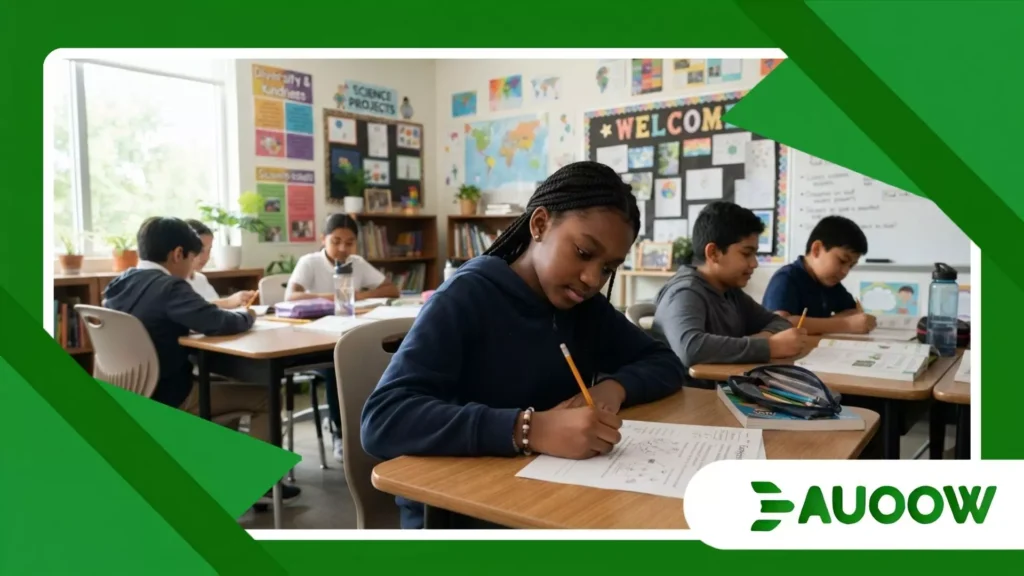
Consider a district-wide pilot program implemented in a mid-sized suburban school district facing rising rates of student disengagement and widening achievement gaps.
Rather than purchasing new single-medium textbooks or spending funds on isolated remedial software, the administration invested in restructuring their core curriculum units using flexible multi-modal resources.
In a seventh-grade science module on cellular biology, students were given immediate options for absorbing information.
They could read traditional text accompanied by embedded screen-reading software, examine interactive 3D digital models, or listen to structured audio summaries with graphic organizers.
When it came time to demonstrate their understanding of cell structures, students selected their mode of delivery based on their strengths.
The results of this shift went far beyond individual test scores.
Discipline referrals dropped during these instructional blocks, and students without formal diagnostic labels such as English language learners and students recovering from chronic illnesses showed significant gains in retention and participation.
The lesson from this case is clear: when learning environments are designed for variability, the need for specialized, stigmatizing interventions declines dramatically.
Also read: Inclusive Education in the Middle East: Emerging Opportunities
What Is the Real Evolution of Classroom Accessibility Policies?
To understand why the integration of universal design for learning in modern schools feels like such a major shift today, we must connect past policy frameworks with contemporary classroom practices.
Educational policy has historically moved through distinct developmental phases, each reflecting the social attitudes of its time.
| Era / Policy Phase | Primary Focus | Practical Classroom Reality | Structural Limitations |
| Exclusionary Era (Pre-1970s) | Institutionalization or home-based isolation | Children with significant disabilities were largely absent from public education. | Complete lack of access or systemic rights. |
| Integrative Phase (1970s–1990s) | Physical access and mainstreaming | Students were placed in regular classrooms with dedicated aides or separate worksheets. | Heavy reliance on individual retrofitting and pull-out models. |
| Architectural Universal Design (1990s–2000s) | Physical accessibility (ramps, captions, door levers) | School buildings became physically accessible; digital media started using captions. | Built environment improved, but instructional design remained rigid. |
| Pedagogical UDL Integration (2010s–Present) | Cognitive accessibility and multi-modal instructional design | Curriculum offers flexible options for perception, engagement, and expression. | Requires ongoing professional training and institutional flexibility. |
When we evaluate this historical continuum, the pattern repeats itself across public systems worldwide.
Early efforts focused entirely on physical presence, while pedagogical methods remained unchanged.
The current policy phase recognizes that physical access without cognitive access leaves the fundamental work of equity unfinished.
Read more: Africa’s Innovative Approaches to Inclusive Learning
Why Is Institutional Resistance Still Blocking Progress?
Despite clear empirical support and backing from policy directives, the broad adoption of flexible educational design encounters persistent resistance.
On my reading of this scenario, the primary obstacle is not student capability or available technology, but an institutional commitment to legacy evaluation tools.
High-stakes standardized testing environments remain overwhelmingly uniform, penalizing schools that depart from traditional instructional routines.
When end-of-year assessments evaluate students exclusively through long-form reading passages and timed multiple-choice questions, administrators understandably hesitate to encourage flexible demonstration methods during daily instruction.
Furthermore, there is a structural detail that is often ignored: teacher training programs continue to treat inclusive methods as a secondary specialization rather than a core instructional skill.
Generational educators are often trained in general pedagogy first, with inclusive strategies added as an isolated elective course.
This separation reinforces the misconception that accessible design is an additional burden rather than the primary mechanism of effective teaching.
What Actually Changed After Modern Frameworks Were Applied?
When schools make the long-term commitment to embed accessibility directly into their instructional culture, the transformations extend well beyond academic metrics.
A prominent public high school in the American Midwest shifted its entire curriculum structure toward flexible representation and expression over a three-year period.
By replacing static homework assignments with choice-based project menus and providing embedded text-to-speech tools across all digital libraries, the administration observed a notable shift in student culture.
Crucially, the stigma associated with using assistive technology vanished.
When every student in a classroom has access to speech-to-text tools, digital graphic organizers, and audio materials, using those tools no longer identifies a child as “different.”
Accessibility becomes as ordinary and unremarked upon as wearing glasses or using a flexible desk chair.
Reimagining the Future of Educational Infrastructure
The analysis suggests that the future of public education will not be defined by the creation of specialized apps or isolated assistive devices, but by how courageously institutions rethink their baseline environments.
For over a century, school systems operated under the assumption that students must adapt to the rigid structure of the school or accept exclusion.
Moving toward universal design for learning in modern schools reverses that historical assumption, placing the burden of adaptability squarely where it belongs: on the design of the learning environment itself.
When we observe classrooms where flexible pathways are built into the daily routine, we witness a fundamental shift in how human potential is nurtured.
A child who cannot read dense text efficiently is no longer forced to feel incapable of understanding complex history; a student who struggles with verbal expression is given the space to articulate sophisticated technical concepts visually or structurally.
The barriers that once felt like personal limitations fall away, exposing them for what they always were flaws in the system’s design.
Achieving this level of accessibility requires more than adopting new terminology or buying software.
It demands that school boards, policy makers, and teacher preparation programs align their incentives with real-world human variability.
It requires acknowledging that standardization was a convenience for an industrial era that has passed, while flexibility is an imperative for an inclusive society.
As education systems continue to evolve, the measure of a school’s quality will no longer be how well its students fit into a rigid mold, but how effectively its infrastructure opens doors for every mind that steps through them.
By grounding our educational philosophy in flexibility, dignity, and shared access, we build spaces where difference is no longer an obstacle to overcome, but the very foundation upon which meaningful learning thrives for every student who enters a classroom.
FAQ Editorial
What is the difference between UDL and traditional special education accommodations?
Traditional accommodations are reactive modifications created for an individual student after a barrier is identified, such as providing an audio version of a text for a student with an Individualized Education Program (IEP).
In contrast, the framework for universal design for learning in modern schools is proactive; it designs the lesson from the start with audio, visual, and text options built-in for all students, reducing the need for isolated modifications.
Does flexible curriculum design lower academic standards for students?
No. The core learning standards remain rigorous and unchanged. The framework separates the learning objective from the vehicle used to demonstrate mastery.
A student studying cause and effect in history must still show analytical depth, evidence evaluation, and logical structure, regardless of whether they deliver that analysis in a written essay or a structured audio presentation.
How can schools implement these flexible methods on tight budgets?
Implementation depends far more on instructional culture and thoughtful planning than on expensive hardware.
Many effective adjustments such as offering choices in assignment formats, providing clear visual rubrics, breaking complex instructions into manageable steps, and utilizing open-source digital tools require no additional capital expenditure, relying instead on ongoing professional development.
Is universal design only beneficial for neurodivergent students or those with disabilities?
While designed to ensure access for students with diverse learning needs, the benefits extend across the classroom.
English language learners, students recovering from illness, advanced learners seeking flexible challenges, and students experiencing temporary stress all benefit from having multiple ways to engage with content and express their understanding.
