
Lessons from Schools That Are Leading Inclusion Innovation
The lessons from schools that are leading inclusion innovation show us that transformative education begins long before a student steps through the classroom door.
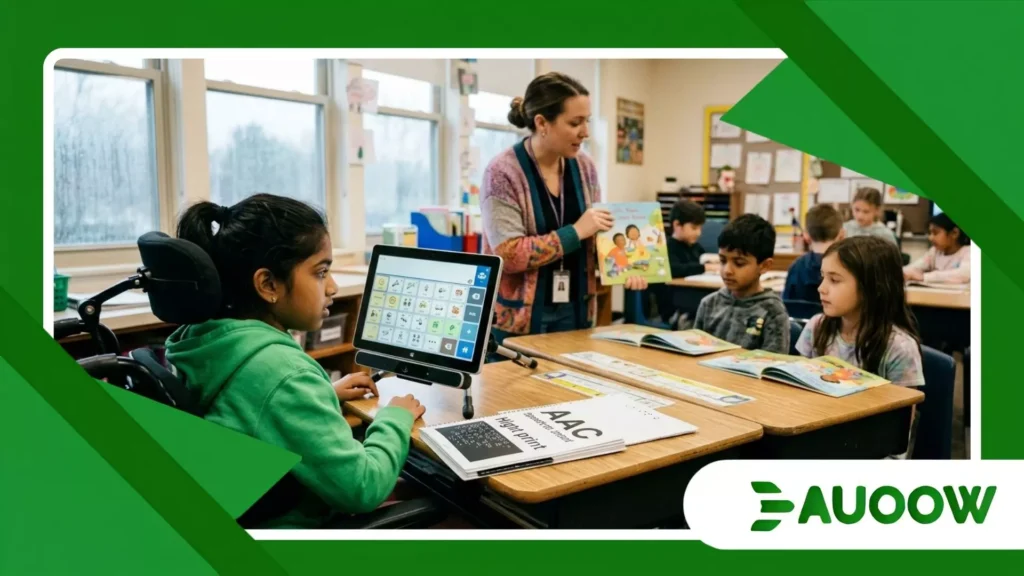
On a damp Tuesday morning in a mid-sized suburban district, nine-year-old Maya sits at her desk waiting for the morning literacy block to begin.
Maya has cerebral palsy and relies on a customized speech-generating device alongside high-contrast tactile materials to navigate complex reading passages.
In a conventional classroom, this transition involves a flurry of rushed searching: a missing power cable, an unformatted digital document, or an aide hovering so closely that Maya rarely speaks directly to her peers.
Today, however, the file is already loaded onto her system, calibrated to her eye-gaze settings, while her teacher launches a group reading activity where every child accesses the exact same story through different sensory pathways. Nothing feels forced or extra; it simply feels like school.
Key Themes in This Article
- The Hidden Mechanics of Modern Educational Inclusion
- Architectural and Digital Equity Beyond Compliance
- Lessons from schools that are leading inclusion innovation
- Policy Gaps and the Economics of Classroom Support
- What Actually Changed After Systemic Reform?
- Questions Frequently Asked by Families and Educators
The Hidden Mechanics of Modern Educational Inclusion
For decades, public education treated accessible design as a series of retrofits physical ramps tacked onto century-old entrances or resource rooms tucked away at the far end of administrative corridors.
What we observe today in pioneering districts is a fundamental departure from that legacy.
The shift moves away from accommodating individual students after a curriculum fails them, moving instead toward designing environments that anticipate human variation from the very first blueprint.
Why Do Structural Barriers Persist in Modern Classrooms?
When we examine why many school districts struggle with true integration, the obstacle is rarely a lack of empathy among teachers. The deeper issue rests in how educational systems were historically built.
For nearly a century, standardized education operated on an industrial model. Curricula, classroom layouts, and assessment metrics were engineered around an idealized average student.
Anyone falling outside those parameters required a waiver, an exemption, or a specialized add-on service.
What rarely enters the conversation is how deeply this legacy architecture influences budget allocations and teacher preparation today.
School boards routinely spend significant funds on reactive interventions after-the-fact accommodations, legal disputes, and emergency staffing rather than investing upfront in flexible learning environments.
There is a structural detail that often gets overlooked: accessibility is not a tech support ticket or a specialized software license.
It is an editorial and pedagogical choice made long before instruction begins. Inclusion succeeds when it ceases to be managed as an auxiliary service and becomes the core infrastructure of the institution.
++ Preparing Disabled Students for Career Success Before Graduation
Architectural and Digital Equity Beyond Compliance
How Are Progressive Educators Redefining Assistive Technology?
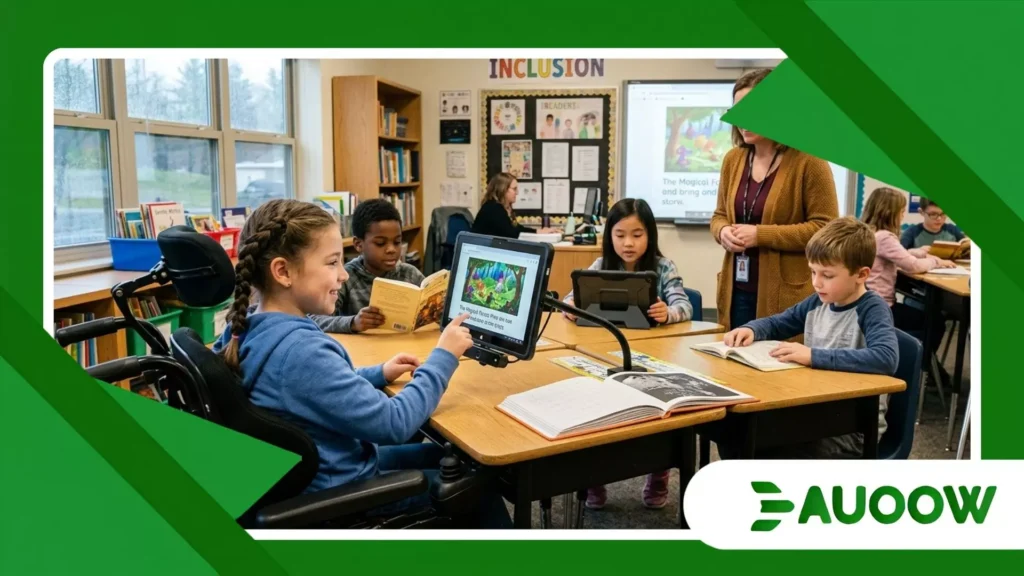
In districts that are quietly modernizing access, assistive technology is no longer treated as a separate category of medical equipment.
Instead, tools previously reserved for specialized education are embedded directly into the general learning ecosystem.
Consider how a middle school history lesson unfolds when universal access is prioritized.
Textbooks are not handed out solely as printed paper; they exist simultaneously as screen-reader-optimized digital text, structured audio files, and tactile visual graphics.
When every student in a classroom has access to text-to-speech toggles or predictive writing tools, the social stigma attached to using adaptive equipment vanishes.
When an accommodation is available to everyone, it stops functioning as a mark of difference and starts functioning as a tool for learning.
The insights gathered from these forward-thinking learning environments reveal that hardware alone solves very little.
High-tech tools given to untrained staff frequently end up stored in classroom closets.
The real breakthrough happens when professional development focuses on flexible instruction, allowing educators to design units with multiple means of engagement, representation, and expression from day one.
Also read: Inclusive Education in the Middle East: Emerging Opportunities
What Does Equity Look Like in Daily School Routines?
To understand how systemic change functions on a human scale, consider a typical public school district updating its approach to physical and cognitive access.
Imagine a seventh-grade science lab designed around collaborative group projects.
In a traditional setting, a student using a motorized wheelchair might be assigned to a separate, height-adjustable table placed along the back wall, isolated from their lab partners.
In a school committed to functional equity, every lab station features modular, adjustable-height counters and accessible sink fixtures.
The physical layout anticipates mobility variations as a standard feature rather than an afterthought.
The difference between these two scenarios is not merely physical; it is profoundly psychological.
When a student is continually removed from the group to access basic learning materials, the institution implicitly communicates that their presence is an anomaly.
When the environment bends to accommodate diverse physical and sensory needs, the focus returns to scientific inquiry, critical thinking, and social collaboration.
The key distinction lies between passive compliance with legal standards and active commitment to human dignity.
Federal regulations like IDEA and Section 504 establish minimum legal thresholds, but compliance alone does not guarantee a belonging-focused culture.
Schools that lead in this space treat legal mandates as a floor rather than a ceiling.
Read more: Africa’s Innovative Approaches to Inclusive Learning
Lessons from Schools That Are Leading Inclusion Innovation
How Do Historic Civil Rights Laws Shape Today’s Innovations?
The journey toward modern inclusive classrooms cannot be understood without examining the legislative foundations laid decades ago.
The passage of the Individuals with Disabilities Education Act (IDEA) and the Americans with Disabilities Act (ADA) fundamentally changed public education by establishing access as a civil right rather than a charitable gesture.
However, historical policies often created unintended silos. Early legislative frameworks encouraged the creation of separate special education tracks a system that protected rights while accidentally institutionalizing physical and social separation.
Over time, researchers and advocates began to recognize that segregation in early education led directly to systemic inequities in higher education, employment, and civic participation later in life.
When we connect past legislative battles to current classroom practices, we see that modern pedagogical innovation is the natural evolution of civil rights activism.
The transition from physical presence to meaningful instructional participation represents the current frontier of educational equity.
The lessons from schools that are leading inclusion innovation illustrate that modern technology is most effective when guided by historic civil rights principles.
Policy Gaps and the Economics of Classroom Support
Despite clear evidence supporting fully integrated educational models, significant systemic gaps remain across many public school systems.
The most persistent vulnerability is the chronic underfunding of essential support infrastructure.
While federal mandates require schools to provide free and appropriate public education in the least restrictive environment, national funding mechanisms consistently fall short of original statutory targets. This fiscal shortfall creates severe friction at the local level.
School administrators are often forced to make painful tradeoffs between purchasing adaptive classroom technologies, hiring specialized support staff, or investing in ongoing professional development for general education teachers.
In under-resourced districts, this financial tension routinely results in delayed evaluations, insufficient staffing, and reliance on outdated accommodations.
Furthermore, urban and rural districts face vastly different structural realities when executing these frameworks.
While affluent suburban schools can invest in state-of-the-art adaptive hardware and dedicated instructional coaches, lower-income districts frequently struggle to maintain basic staffing ratios.
Inclusion cannot become a luxury reserved for specific ZIP codes; it must function as a universal standard across the entire public education landscape.
Addressing this disparity requires moving beyond piecemeal grants and temporary funding initiatives.
It demands structural reform in how public education is financed, ensuring that capital investments in accessible architecture, digital infrastructure, and specialized professional training are sustained as core operational expenses.
What Actually Changed After Systemic Reform?
| Educational Dimension | Legacy Framework | Integrated Innovation Framework | Systemic Impact |
| Curriculum Design | Static print materials with reactive modifications | Multi-modal, digital-native content designed via UDL | Reduced administrative delays in delivering accessible materials |
| Physical Space | Standard desks with isolated accessible stations | Modular, fully adjustable furniture across all rooms | Enhanced social interaction and peer collaboration |
| Assistive Tech | Dedicated, stigmatized devices assigned individually | Embedded accessibility features across standard hardware | Increased usage rates and reduced social anxiety |
| Staffing Model | Isolated special education aides assigned to specific students | Collaborative co-teaching and universal instructional design | Broader support availability for all classroom learners |
The shift from reactive accommodations to systemic design redefines the relationship between students and their learning environment.
When schools eliminate the physical and administrative friction that isolates learners, education shifts from a system of individual waivers to a shared cultural infrastructure.
The long-term impact extends beyond academic performance; it establishes early social expectations around human diversity, equity, and mutual respect that students carry far beyond the classroom wall.
Questions Frequently Asked by Families and Educators
Does universal classroom design compromise academic rigor for non-disabled students?
No. Research shows that universal design principles benefit all learners by offering multiple pathways to process and demonstrate mastery of complex material.
Features like clear visual structures, multi-modal instructional materials, and flexible seating enhance focus and comprehension across diverse learning styles without lowering expectations.
How do schools balance specialized individual support with full classroom inclusion?
Leading schools utilize a co-teaching model where general education and special education teachers plan and lead lessons together.
This approach allows specialized interventions such as speech therapy strategies, behavioral support, or sensory breaks to be integrated directly into the daily routine without isolating individual students from their peers.
What is the most common mistake districts make when implementing assistive technology?
The most frequent misstep is purchasing advanced hardware or software without providing comprehensive, ongoing training for classroom teachers, support staff, and families.
Technology alone cannot drive inclusion; it requires thoughtful integration into the daily curriculum alongside clear strategies for usage.
How can older school buildings be updated for full accessibility on limited budgets?
While structural renovations require long-term capital planning, significant accessibility gains can be made immediately through tactical improvements.
These include reorganizing classroom layouts, installing low-cost automatic door openers, ensuring smooth pathways, incorporating flexible modular furniture, and prioritizing digital accessibility for all instructional content.
