
What Inclusive Classrooms Could Look Like by 2030
When an eight-year-old boy named Leo walked into his third-grade room last September, the first thing he did was reach for his noise-canceling headphones.
Diagnosed with autism and sensory processing sensitivity, Leo spent most of his previous school year sitting near the doorway, ready to slip into the hallway whenever the fluorescent lights hummed too loudly or thirty children shuffled their chairs at once.
Today, his school in a working-class suburb outside Manchester uses soft acoustic paneling, indirect lighting, and spatial zoning designed with neurodivergent students in mind.
It is a subtle shift, yet it quietly reframes what inclusive classrooms could look like by 2030 when we design learning environments around human diversity rather than forcing children to adapt to rigid historical architectures.
In This Article
- The Architecture of Belonging: Moving beyond physical entry to true spatial access.
- Technology as an Equalizer: How adaptive AI and assistive tech shift from accommodations to baseline tools.
- Policy vs. Practice: Bridging the gap between legal mandates and daily classroom reality.
- A Comparison of Educational Models: How pedagogical approaches are shifting over the decade.
- Editorial FAQ: Direct answers to pressing questions on the future of inclusive education.
Why do traditional school layouts still fail so many children?
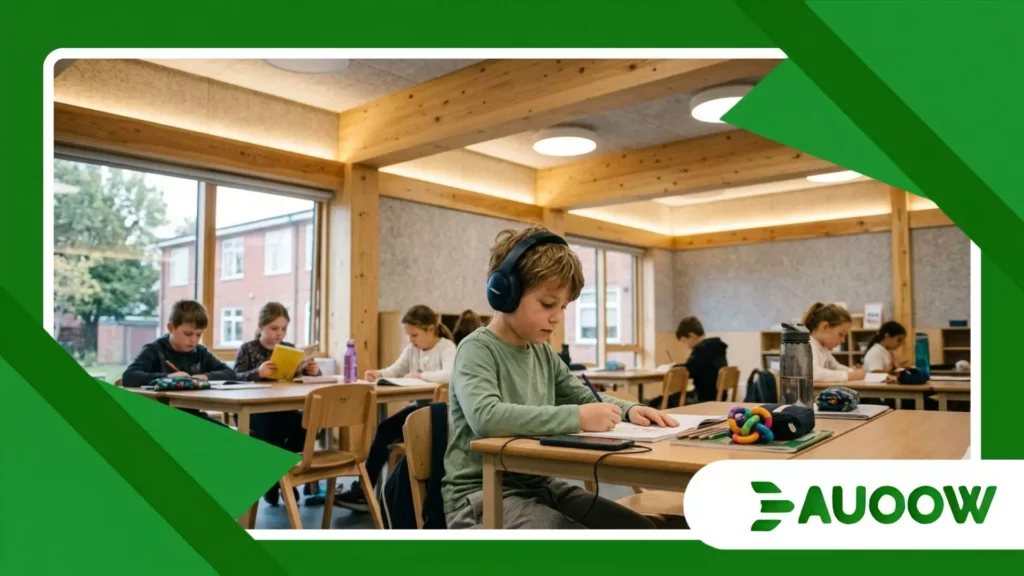
For over a century, the basic geometry of the classroom barely changed. Rows of desks faced a blackboard, built on an industrial efficiency model that assumed every student absorbed information at the same pace, through the same sensory channels.
When we examine why physical and pedagogical barriers persist, we find that institutional inertia often outweighs pedagogical science. School infrastructure was historically designed for batch processing, not individualized learning.
There is a structural detail that is usually overlooked in debates about educational reform: accessibility has long been treated as a retroactive patch rather than a foundational blueprint.
When a school installs a ramp at the back entrance near the loading dock, it fulfills a legal requirement under statutes like the Americans with Disabilities Act or the UK’s Equality Act. Yet, it sends a clear social message about who belongs at the front entrance.
When we look closer, the pattern repeats across curricula. Braille texts arrive weeks after the school term begins; digital portals remain incompatible with screen readers; acoustic environments trigger sensory overload.
The barrier is rarely a lack of goodwill among teachers. It is the systemic persistence of design choices made decades ago that prioritized administrative uniformity over human variability.
++ Preparing Disabled Students for Career Success Before Graduation
How will adaptive technology transform everyday learning?
Over the past decade, assistive devices moved from specialized, stigmatized equipment to mainstream consumer software.
In reporting across public school districts, the most profound changes occur when specialized tools become invisible.
By exploring what inclusive classrooms could look like by 2030, we see a future where personalized digital learning environments remove the line between assistive and standard technology.
Consider a middle school history class in 2030. A student with dysgraphia uses real-time speech-to-text with contextual predictive engine support, while a classmate with attention differences uses dynamic spatial audio to filter out ambient room noise.
Neither student feels singled out, because every child in the room utilizes a customized digital workspace calibrated to their cognitive profile.
The real revolution is not the hardware itself, but the shift in pedagogical philosophy.
What rarely enters the debate about classroom AI is how these tools can prevent educational tracking the damaging practice of routing disabled students into less ambitious academic tracks.
When software dynamically adjusts reading levels or provides visual scaffolding without changing the underlying conceptual rigor, a child with intellectual or learning disabilities stays fully engaged in the same high-level discussion as their peers.
What happens when access moves from retrofits to universal design?
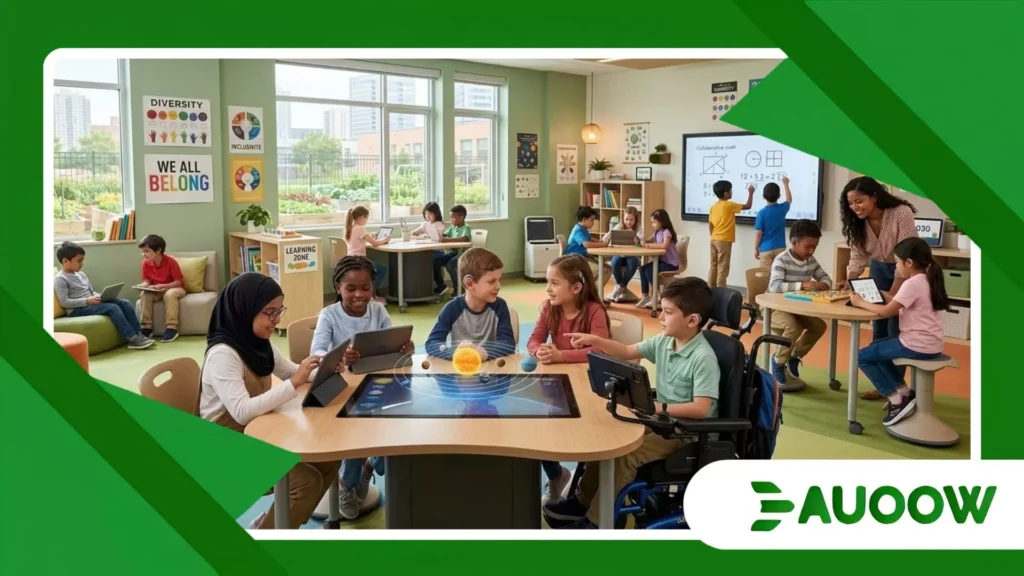
Universal Design for Learning (UDL) is not an abstract framework; it is an operational standard.
Instead of creating a lesson plan and then creating modifications for a student with an Individualized Education Program (IEP), educators design learning experiences from the outset with multiple means of engagement, representation, and expression.
Imagine a high school science lab. In a traditional setting, a student who uses a wheelchair might be assigned to a separate, lower station at the back of the room, isolated from their lab partners.
In a modern space built on UDL principles, every lab workbench features hydraulic height adjustments, touch-sensitive instruments, and visual signal indicators alongside audible alarms.
Access is no longer an afterthought; it is integrated directly into the physical infrastructure.
Also read: Inclusive Education in the Middle East: Emerging Opportunities
What is the historical link between disability rights laws and classroom realities?
The journey toward educational inclusion has always been tied to legal battles.
In the United States, the passage of the Education for All Handicapped Children Act in 1975 later evolving into the Individuals with Disabilities Education Act (IDEA) marked a civil rights milestone.
Similar legislative shifts occurred across Europe, Latin America, and Asia over subsequent decades, establishing that every child has a right to a free, appropriate public education in the least restrictive environment.
Yet, passing a law is quite different from funding its execution.
Honest analysis suggests that while legal mandates succeeded in opening physical school doors, they frequently left schools under-resourced to handle the complex social and pedagogical realities of true integration.
Decades after these landmark bills, many school systems still operate on procedural compliance rather than cultural inclusion.
Special education departments often work in silos, separated from general education budgets and curriculum planning.
To understand what inclusive classrooms could look like by 2030, we must trace how past policy failures drive current reform.
The focus is shifting away from checking legal boxes and toward building sustainable funding models that support co-teaching, low student-to-teacher ratios, and ongoing professional development in accessibility.
Why is teacher training the critical factor for real change?
Technology and flexible furniture cannot transform an environment without skilled, supported educators.
For too long, teacher training programs treated special education as a separate discipline a specialized module reserved for those intending to work exclusively in self-contained rooms.
That approach is fundamentally outdated. Today’s educators require continuous, practical training in neurodiversity, positive behavioral support, and collaborative co-teaching strategies.
When a general education teacher and a special education specialist work as equal partners in the same room, the dynamic shifts completely.
The responsibility for supporting disabled students stops resting on a single paraprofessional and becomes a shared educational objective.
Read more: Africa’s Innovative Approaches to Inclusive Learning
How do socio-economic gaps impact educational access worldwide?
While well-funded urban and suburban districts experiment with sensory rooms and advanced assistive technology, millions of children in under-resourced regions still lack basic physical access to classrooms.
We cannot discuss global educational trends without confronting this deep inequality.
In many developing economies, the primary barrier remains foundational infrastructure: unpaved paths, lack of accessible transport, absence of basic sanitary facilities, and severe shortages of trained personnel.
However, innovative low-tech solutions are demonstrating that meaningful inclusion does not always require high budgets.
In rural districts across Kenya and India, community-led initiatives leverage local materials to build accessible ramps, create tactile learning aids from recycled objects, and train peer-mentors to support disabled classmates.
These models show that genuine inclusion is rooted in community attitudes and pedagogical intent, not just technology budgets.
When we consider what inclusive classrooms could look like by 2030 on a global scale, the primary goal must be closing the resource gap.
International aid organizations, national governments, and civil society groups must ensure that technological advances do not widen the divide between wealthy districts and underfunded public schools.
How pedagogical approaches are changing
To understand the scope of this evolution, it is helpful to look at how fundamental aspects of schooling are shifting from traditional setups toward the inclusive standards expected by 2030.
| Feature / Dimension | Traditional Classroom Model | Intermediate Integration (2010s-2020s) | Fully Inclusive Classroom (2030 Target) |
| Physical Space | Fixed desks, rigid rows, centralized board | Standard layout with retrofitted ramps and stations | Flexible, sensory-zoned, hydraulics-adjustable furniture |
| Assistive Technology | Isolated, specialized devices; often stigmatized | Personal tablets with added accessibility apps | Seamlessly integrated, universal digital learning tools |
| Curriculum Design | One-size-fits-all; retroactive accommodations | Modified assignments created on request (IEP driven) | Universal Design for Learning (UDL) built-in from start |
| Staffing Structure | Single teacher; isolated special-ed support | General teacher + part-time aide/paraprofessional | Co-teaching model (General + Special Ed specialists) |
| Social Dynamics | Assimilation; disabled students adapt to room | Mainstreaming with occasional pull-out sessions | Total social cohesion; environment adapts to diversity |
What steps must communities take to achieve this vision?
Reimagining educational environments is not a passive process. It requires deliberate choices from policymakers, school boards, parents, and urban planners.
If we want schools that welcome every child, society must invest in infrastructure, reform educator preparation, and involve disabled people in educational design.
From my perspective, the most honest assessment of this transition reveals that the primary obstacle is rarely technical feasibility; it is political and cultural will.
When districts prioritize inclusion in their master budgets rather than treating it as a discretionary line item, classrooms transform rapidly.
When we reflect on what inclusive classrooms could look like by 2030, we see that accessible design benefits every single learner.
A quiet corner designed for an autistic child offers a retreat for a student grieving a personal loss.
Clear visual schedules built for non-verbal students help English language learners navigate their day.
Sound field systems installed for hearing-impaired children improve reading retention for the entire class.
By designing for the margins, we create stronger, more resilient educational spaces for everyone.
Editorial FAQ
What is the difference between integration and true inclusion in education?
Integration places disabled students into existing, unchanged environments, expecting them to adapt to traditional structures with minor accommodations.
True inclusion changes the environment, curriculum, and teaching methods beforehand, ensuring the space naturally accommodates human variation without requiring individuals to conform.
Will AI and digital technology replace specialized human support in classrooms?
No. Advanced software and digital tools are meant to reduce administrative burdens and provide dynamic learning scaffolding, freeing educators to focus on human connection.
Assistive technology enhances the capabilities of teachers, special education experts, and paraprofessionals; it does not replace them.
How do fully inclusive classrooms affect non-disabled students?
Research consistently shows that inclusive classrooms benefit all learners.
Non-disabled students develop higher levels of empathy, stronger communication skills, and greater social adaptability.
Furthermore, Universal Design for Learning strategies such as multimodal instructions and flexible environments help improve academic outcomes across the student body.
Is implementing Universal Design for Learning prohibitively expensive for public schools?
While initial infrastructure upgrades and professional development require capital investment, universal design reduces long-term costs associated with retrofitting outdated spaces, purchasing proprietary single-user software, and managing legal disputes over non-compliance.
Building accessibility in from the start is systematically cheaper than adding it retroactively.
